Last updated: June 30th, 2026
An effective SEO content marketing strategy for a small business means matching content format to where you currently stand: metrics pieces and how-to guides if you’re starting from low domain authority, service and use case pages once you’ve built some traffic, and superlative or broad commercial content once you’re established enough to compete for it.
Most businesses approach content marketing backwards. They create blog posts based on what they want to say rather than what their audience needs to know. They publish without a clear strategy for which content types serve which purposes. And they wonder why their content doesn’t rank, doesn’t convert, or doesn’t drive meaningful business results.
Successful content marketing requires understanding two fundamental principles: how to answer search intent in the most psychologically pleasing manner, and which content formats work best for different stages of domain authority and business maturity.
This guide explains both. We’ll walk through the psychology of search intent optimization, break down the major content types available in your content marketing arsenal, and show you exactly when each format makes strategic sense based on your competitive position and business goals.
In this guide, you’ll discover:
- How to structure content that answers search intent in the most psychologically satisfying way
- The major content types (metrics pieces, service pages, landing pages, location pages, use cases, how-to guides, FAQs, and superlative content)
- Strategic deployment frameworks based on domain authority and competitive landscape
- Real examples of content that ranks and converts in competitive markets
- How to prioritize content creation based on your current business stage
Understanding Search Intent: The Foundation of Effective Content
The difference between content that ranks and content that gets ignored comes down to one principle: good content answers search intent in the most psychologically pleasing manner.
This goes beyond simply providing accurate information. It means structuring that information in a way that immediately satisfies the user’s cognitive needs, reduces friction, and builds trust through clarity and comprehensive depth.
The Psychology of Information Architecture
When someone searches for information online, their brain follows a predictable pattern of needs:
| The Psychology Behind Search Intent |
|---|
|
Immediate validation: They want a clear, direct answer within the first few seconds Contextual depth: They need breakdowns that match their specific situation Decision frameworks: They’re looking for organized information that supports planning Trust signals: They want data, sources, and comprehensive coverage that proves expertise |
Consider how this works in practice. When someone searches “average cost to build a house,” they’re not looking for a philosophical discussion about construction economics. They want a number first, then they want to understand how that number applies to their location, their project type, their quality expectations, and their timeline.
Content that satisfies this psychological need structure performs better in search results because it generates positive user signals: longer time on page, lower bounce rates, more internal clicks, and higher conversion rates. These signals tell search engines that the content successfully fulfilled the query.
How to Structure Content for Psychological Satisfaction
The most effective content follows a progressive segmentation model:
| How to Structure Content |
|---|
|
Answer the primary question immediately in the opening paragraph with specific figures or clear statements Provide the first level of segmentation that addresses the most common variable (usually geography or category) Add deeper segmentation layers that let users refine based on additional factors Include a comprehensive context that explains why variations exist Offer decision support frameworks that help users apply the information Close with clear next steps or actionable takeaways |
This structure works because it meets users where they are psychologically. They get instant gratification from the immediate answer, then progressively discover the nuance and depth they need to make informed decisions.
Content Types and Strategic Deployment
Now that you understand how to structure content to satisfy search intent, let’s examine the specific content formats available and when each makes strategic sense.
1. Metrics Pieces: Comprehensive Data-Driven Content
What they are: In-depth articles that answer quantitative questions (costs, timelines, statistics, comparisons) with extensive tables, regional breakdowns, and comprehensive analysis.
| Examples |
|---|
|
• “Average Cost Per Square Foot for Commercial Construction” • “Average Cost to Remodel a Kitchen” |
Why they work: Metrics pieces target high-volume commercial keywords where users have clear informational intent but are often in the early stages of a buying journey. These articles:
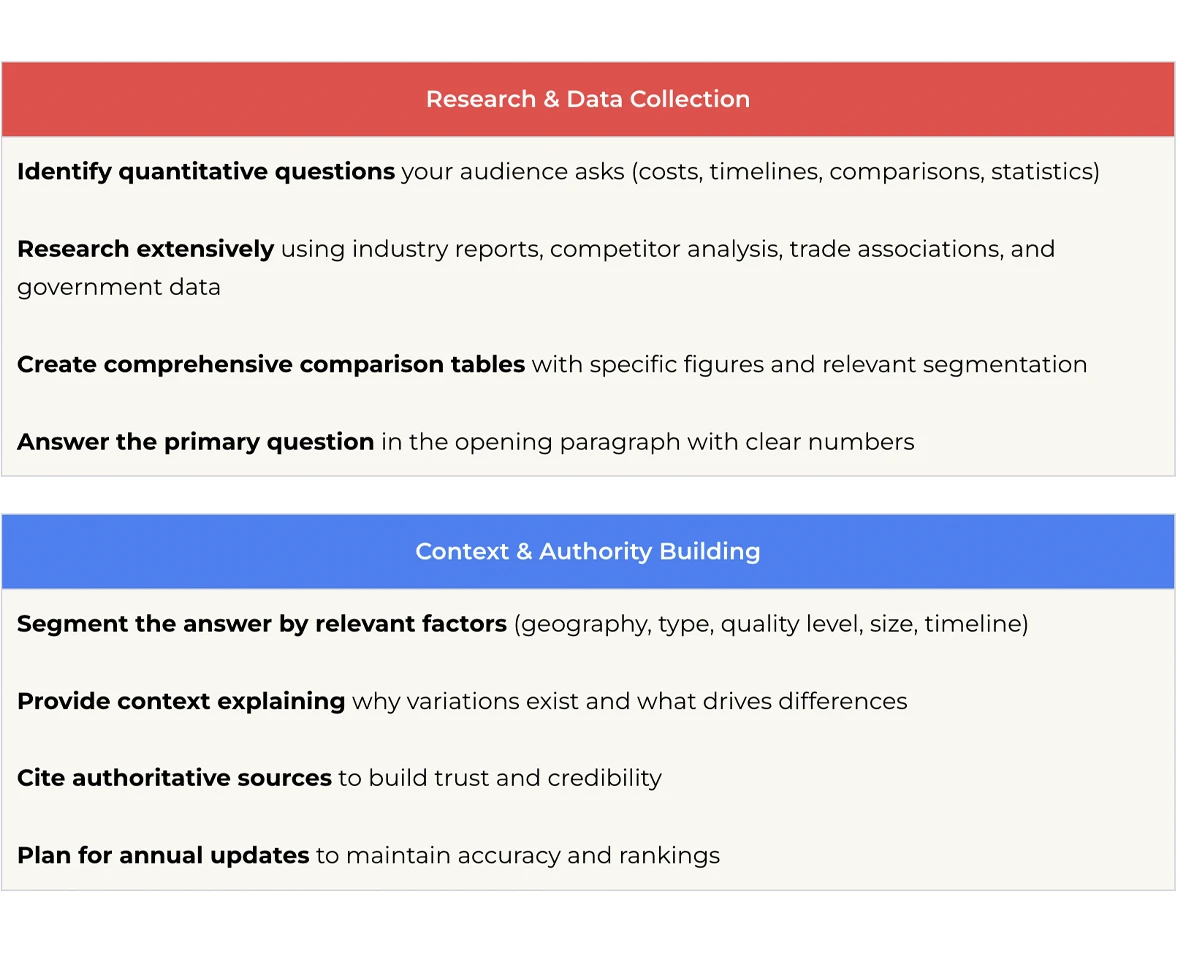
How to create effective metrics pieces:
| Research & Data Collection |
|---|
|
Identify quantitative questions your audience asks (costs, timelines, comparisons, statistics) Research extensively using industry reports, competitor analysis, trade associations, and government data Create comprehensive comparison tables with specific figures and relevant segmentation Answer the primary question in the opening paragraph with clear numbers |
| Context & Authority Building |
|---|
|
Segment the answer by relevant factors (geography, type, quality level, size, timeline) Provide context explaining why variations exist and what drives differences Cite authoritative sources to build trust and credibility Plan for annual updates to maintain accuracy and rankings |
For new websites with low domain authority, metrics pieces represent the single most effective content type because they can earn backlinks even when your site has limited authority. Other content creators naturally link to comprehensive data resources when building their own guides and comparisons.
2. Superlative Content: Recommendation and Comparison Content
What they are: “Best,” “top,” or comparison articles that evaluate options and make recommendations.
| Examples |
|---|
|
• “Best Accounting Software for Small Businesses” • “Top Analytics Platforms for Enterprise Companies” |
Why they matter: Superlative content captures high-intent users in the evaluation and decision-making stages. These searchers are actively comparing options and often ready to make a purchase or hiring decision, making superlative content valuable for conversions.
How to create effective superlative pieces:
| Methodology & Credibility |
|---|
|
Clear evaluation criteria and methodology: Explain how you’re comparing options (features, pricing, ease of use, customer support, etc.) Specific pros and cons for each option: Don’t just list features – explain advantages and disadvantages Direct experience or comprehensive research: Base recommendations on actual use, testing, or thorough investigation Transparent scoring or ranking system: If rating numerically, show how you arrived at scores Trust signals: Include expert opinions, user reviews, testing data, certifications, or hands-on experience |
| Usability & Presentation |
|---|
|
Use case recommendations: “Best for [specific scenario]” helps readers identify their fit Pricing transparency: Include cost ranges and value analysis Regular updates: Products/services change – keep content current with update dates Clear winner or final recommendations: Don’t leave readers hanging – provide actionable conclusions Comparison tables: Visual side-by-side comparisons for easy scanning |
3. Service Pages: Commercial-Intent Conversion Content
What they are: Pages describing specific services you offer, optimized for commercial-intent keywords where prospects are actively evaluating providers.
| Examples |
|---|
|
• “Whole-Home HVAC Replacement and Installation” • “Sports Physical Therapy and Injury Prevention” |
Why they matter: Service pages capture qualified traffic from users with clear buying intent. These visitors convert at significantly higher rates than informational traffic because they’re actively looking for solutions.
| Essential Elements for Service Pages |
|---|
|
Clear H1 that includes the primary keyword Above-fold value proposition explaining your differentiation Comprehensive scope explanation with specific deliverables Process overview showing how you work Pricing context or budget guidance Social proof through testimonials and results FAQ section addressing common objections Prominent call-to-action |
4. Location Pages: Geographic-Specific Service Content
What they are: Pages targeting “[service] in [city]” or “[service] [neighborhood]” searches for businesses serving multiple geographic areas.
| Examples |
|---|
|
• “Chiropractic Care in San Diego” • “HR Consulting Services in Boston, MA” • “Residential Roofing Contractor in Charlotte, NC” |
Why they work: Location pages capture users with strong local intent who are searching for services in their specific area. These searches typically have higher conversion rates because the user has already filtered by geography, indicating they’re ready to engage with a local provider.
| Critical Success Factors for Local Content |
|---|
|
Substantive unique content for each location Specific local details and proof points Clear explanation of why your service matters in this location Local citations and backlinks to support rankings Proper local schema markup and NAP consistency |
5. Use Case Pages: Segment-Specific Solution Content
What they are: Pages describing how your service applies to specific industries, project types, company stages, or problem scenarios.
| Examples |
|---|
|
• “Catering Solutions for Corporate Event Planners” • “Accounting for Real Estate Investment Firms” • “Marketing Strategy for Healthcare Technology Companies” |
Why they work: Use case pages capture prospects’ thinking, “Does this work for someone like me?” They rank for long-tail combinations of service + industry or service + scenario and convert well because they demonstrate specific relevance.
| Problem Definition & Solution Fit |
|---|
|
Clear problem statement identifying specific challenges this segment faces Explanation of why general solutions fall short and what makes this use case unique Tailored approach showing how your service adapts to this specific scenario Process overview with specific steps for this use case Relevant case study or example demonstrating real results for this type of client |
| Implementation & Outcomes |
|---|
|
Unique considerations or special factors that affect this segment Realistic expectations with specific outcomes and timelines Next steps with a CTA tailored to this audience Industry-specific language and terminology that resonates with the target segment Demonstration of deep understanding of their particular pain points and operational reality |
6. How-To Guides: Educational Authority Content
What they are: Step-by-step instructional content teaching users how to accomplish specific tasks or solve particular problems.
| Examples |
|---|
|
• “How to Know When Your HVAC System Needs Replacement” • “How to Choose the Right Dental Insurance Plan” |
Why they work: How-to guides work at any domain authority level because they target informational intent, where Google rewards genuinely helpful content regardless of site authority. This makes them excellent for new websites, building initial traffic and authority.
7. FAQ Content: Conversion Support and Featured Snippet Opportunities
What they are: Question-and-answer format content addressing common concerns, objections, and informational needs.
| Two Strategic Applications |
|---|
|
1. On-page FAQ sections: Add 5-8 relevant questions to service pages and landing pages to address objections and concerns that prevent conversions. Use FAQ schema markup for rich results opportunities. 2. Standalone FAQ pages: Create comprehensive FAQ resources targeting question-based keywords with potential for featured snippet rankings. Each answer should provide a direct response in 2-3 sentences, followed by supporting detail. |
Why they work: FAQ content serves dual purposes: conversion optimization and search visibility. On service pages and landing pages, FAQs address objections and concerns at the exact moment prospects are evaluating whether to take action, directly improving conversion rates by removing barriers to decision-making.
Strategic Content Prioritization Framework
Strategic Content Prioritization Framework
Your content strategy should align with your current domain authority and competitive position. Use this framework to decide where to focus first.
| Stage | Where You Are | Prioritize | Why |
|---|---|---|---|
| Foundation | New site, low domain authority, little to no organic traffic | Metrics pieces, how-to guides | Both rank on informational intent regardless of authority. Metrics pieces earn backlinks even from a low-authority site because other creators cite comprehensive data. How-to guides build initial topical relevance and traffic without needing to compete on commercial terms. |
| Growth | Some traffic and authority established, ready to capture qualified leads | Service pages, use case pages, location pages (if multi-location) | Once you have a base of informational traffic and some authority, layer in commercial-intent pages that convert. These rely on visitors already trusting your site enough to act, which the foundation-stage content builds. |
| Competitive | Established authority, competing for high-value commercial terms | Superlative content, broad commercial keywords | These formats require enough trust and authority to outrank established competitors and to support a confident, opinionated recommendation. Attempting this too early usually means publishing content that has no chance of ranking against incumbents. |

A simple gut check: if your site is under a year old or you have fewer than a handful of ranking pages, start at Foundation regardless of how much content you want to publish. Skipping ahead to superlative and broad commercial content before you’ve built authority is the most common reason small business content plans stall out without ranking or converting.
Putting It Into Practice
Successful content marketing comes down to three key principles:
- Structure every piece to answer search intent in the most psychologically satisfying way: immediate answer first, then progressive segmentation that helps users find their specific situation.
- Choose content types strategically based on your domain authority and competitive position. New sites need metrics pieces and how-to guides. Established sites can compete for superlative and broad commercial keywords.
- Prioritize comprehensive depth over shallow coverage. One thorough metrics piece with eight detailed tables earns more links and ranks for more keywords than five thin articles on related topics.
Build your content strategy around these frameworks, and you’ll create content that consistently generates qualified traffic, earns natural backlinks, and converts visitors into customers.
To download a copy of this report, please reach out here.
Sources
- Orbit Media: The Content Strategy Framework of the Top 1% of B2B Companies Author: Andy Crestodina Publication: Orbit Media Studios URL: https://www.orbitmedia.com/blog/content-strategy-framework/
- Semrush: 14 Content Marketing Metrics to Track for Success Author: Ankit Vora Publication Date: September 22, 2023 URL: https://www.semrush.com/blog/content-marketing-metrics/