
Updated April 23rd, 2026
This playbook breaks down exactly how to build a GEO & SEO strategy from the ground up, designed specifically for small businesses. Most agencies treat SEO as a content production problem. Publish enough pages, target enough keywords, and eventually the leads show up. For B2B companies with long sales cycles and patient investors, that approach sometimes works. For consumer businesses (med spas, fitness studios, hotels, contractors, and wellness practices), it rarely does.
Consumer businesses operate on appointment-driven economics. Every month without organic leads is a month of paid ads, reliance on referrals, or empty slots on the booking calendar. The strategy has to be faster, more targeted, and more tightly connected to actual revenue than a generic content program.
This is how Altus Marketing builds a GEO and SEO campaign from the ground up. It has 6 stages:
- Discovery: Understanding the business, market, and client
- Competitive Analysis: Knowing exactly what you’re up against
- Keyword Strategy: Finding the right keywords, not just the popular ones
- Content Planning: Building pages that rank and convert
- GEO and AI Authority: Getting recommended beyond Google
- Benchmarks and Measurement: Tracking what actually matters
The result of this process is a Campaign Roadmap with realistic, quarter-by-quarter targets for organic traffic, keyword rankings, AI recommendations, and new client bookings. Here is what that looks like for a fitness gym:
| Metric | Baseline | Q1 | Q2 | Q3 | Q4 |
|---|---|---|---|---|---|
| Organic Sessions/month | 480 | 680 | 950 | 1,300 | 1,700 |
| Page 1 Google Rankings | 18 | 32 | 52 | 78 | 108 |
| AI Platform Recommendations | 4 | 10 | 20 | 36 | 58 |
| New Client Bookings from Organic | 2/month | 4/month | 7/month | 12/month | 18/month |
Now here is how we get there.
Stage 1: Discovery
The Discovery stage is where we learn enough about a business to represent it accurately and attractively to both search engines and potential clients. It is also where we begin to form a realistic picture of what the campaign can achieve given the competitive landscape, current domain authority, and business goals.
Discovery is not a questionnaire. It is an active conversation, and the questions we ask are designed to surface the information that most directly shapes the keyword strategy and content plan.
As we begin to understand the client’s services, market size, and competition, we also start to set initial expectations about the KPIs we will eventually settle on (page one rankings, traffic, bookings, and AI recommendations). We will not have a fully clear picture of those KPIs until we complete the full strategic planning process, but Discovery gives us enough to start calibrating.
Altus Discovery Questions
| Topic | Questions |
|---|---|
| Business Goals | Are you trying to grow overall volume, attract a specific client type, or expand into a new service or location? How aggressively do you want to grow revenue versus protect current margin? |
| Services and Priorities | Which services are most profitable? Which do you most want to grow? What are your upsell and cross-sell pathways? |
| Ideal Client Profile | Who is your best client? What problem did they have before finding you? What words did they use to describe it before they understood what you specifically offer? |
| Existing Marketing | What channels are you currently using? What is working and what is not? What KPIs do you use for each channel? |
| Competition | Who are the local businesses you most want to outrank? Who do you believe is currently beating you on Google? Are they actively investing in SEO or GEO? |
| Brand and Positioning | What makes your business different from every other option in your market? Can a stranger understand that difference in 10 seconds on your homepage? |
| Value Propositions | What specific outcome do your best clients experience that they could not get elsewhere? Is that clearly stated on your website? |
| Trust Signals | What reviews, credentials, case studies, results data, or awards do you currently have available? |
| Resources | What photos, client stories, outcome data, industry publications, or internal research can you share with our team? |
One question matters more than all the others: what words did your clients use to describe their problem before they understood what you specifically do? Those phrases are often the best keywords in the entire campaign, and most businesses have never thought to collect them.
We are not afraid to ask follow-up questions, push back on assumptions, or bring in outside context from the industry to sharpen our understanding. Discovery is where we do the most listening.
Stage 2: Competitive Analysis
Before targeting a single keyword or writing a single page, we need to understand the competitive landscape. The businesses ranking on page one for your target keywords are your real SEO competitors, and they may look very different from the businesses you think of as your local rivals.
For each competitor, we pull the following data:
| Data Point | What It Tells Us | Where to Find It |
|---|---|---|
| Domain Rating (DR) | How much authority they have built and how hard they are to outrank | Ahrefs Site Explorer |
| Do-Follow Domains | The number of quality external sites linking to them | Ahrefs, Backlinks report |
| Ranking Pages | Total pages actively receiving organic traffic | Ahrefs, Top Pages |
| Domain Age | How long has Google been building trust in its site | Domain age checker tool |
| Homepage Meta Title | How strategically they are targeting their most important keyword | Manual review |
| Top Keywords | What is working for them right now, including keywords they have recently lost | Ahrefs, Top Keywords |
| Content Strategy | How aggressively they are publishing and on what topics | Manual review |
Once the matrix is complete, we look for three specific signals:
- A DR gap of 20 points or less, which means you can realistically compete within 12 months
- Keywords that a competitor has recently lost rankings for, which represent fast-entry opportunities
- Topic areas where no competitor has built meaningful content coverage, which are open for the taking
Example Competitor Analysis (Med Spa in Denver)
| Competitor | DR | Do-Follow Domains | Ranking Pages | Domain Age | Total Keywords |
|---|---|---|---|---|---|
| Competitor A (Med Spa) | 38 | 210 | 95 | 9 years | 1,400 |
| Competitor B (Med Spa) | 29 | 88 | 42 | 4 years | 520 |
| Competitor C (Dermatology) | 52 | 430 | 180 | 14 years | 3,100 |
| Your Business | 18 | 34 | 18 | 3 years | 190 |
This tells us immediately that Competitor B is the most realistic near-term target, that Competitor C is a long-term goal, and that the fastest wins will come from topic areas where none of these three have strong content coverage.
Stage 3: Keyword Strategy
With the competitive picture clear and a technically sound website in place, we build the keyword list. This is the stage that most directly determines whether a campaign generates real bookings or just traffic with no conversion value.
The goal is not to rank for as many keywords as possible. It is to rank for the right keywords.
Start with Your Ideal Client Profile
Keyword strategy begins with people, not search engines. Before opening any keyword tool, we get specific about who we are trying to reach and what problems they are trying to solve.
Most businesses make the same mistake: they start with what they offer instead of who they are serving. The result is a keyword list built around services rather than around the real language of the people searching for them.
A strong audience profile looks like this:
Primary client: Women between 35 and 55 who have seen multiple conventional doctors without resolution. They are experiencing fatigue, unexplained weight gain, or hormonal symptoms and are actively searching for a different approach. They are skeptical of generic advice, have done significant research on their own, and respond to specificity and clinical credibility.
That profile immediately points to keywords like “functional medicine for women,” “hormone imbalance specialist near me,” and “chronic fatigue doctor who actually listens” rather than broad, low-intent terms like “doctor near me.”
The Four Keyword Types That Drive Commercial Value
Proximity Keywords (highest booking intent)
These are searches where the client has already decided they want the service and is looking for the closest or most convenient provider.
| Industry | Example Keywords |
|---|---|
| Consumer Health and Wellness | “med spa near me,” “Botox appointment Denver,” “lip filler near me open now” |
| Fitness | “personal trainer near me,” “women’s gym Chicago,” “weight loss coach Denver” |
| Construction | “kitchen remodel contractor near me,” “bathroom renovation company [city],” “home addition builder near me” |
| Hospitality | “boutique hotel downtown Nashville,” “pet friendly hotel near me,” “hotel with rooftop bar [city]” |
The Altus Keyword Vetting Criteria
Every keyword passes through four filters before entering the campaign:
| The 4-Question Keyword Vetting Criteria |
|---|
|
1. Is it transactional? Would someone searching this be likely to book or buy? 2. Does it autofill in Google’s search bar in a list of 10? 3. Can your site realistically rank for it within 12 months? 4. Do you already rank in the top 3 for it? |
The Altus Keyword Vetting Criteria
Every keyword we target represents a real investment: research time, writing time, and the ongoing cost of maintaining a page that needs to earn its place. That is why we do not add a keyword to a campaign simply because a tool says it has volume. Every keyword passes through four checks before we commit to building a page for it.
1. Is the keyword transactional?
Consumer businesses do not have the luxury of building large audiences and waiting for them to convert. A med spa, a personal training studio, or a boutique hotel needs clients, not readers. That means every keyword we target needs to have a plausible path to a booking.
We think about transactional intent in two tiers:
- Ready to Book: The searcher has made the decision and is looking for the right provider. They are not comparing options or doing research. They want to find someone, confirm they are credible, and schedule. Examples: “med spa near me,” “personal trainer Chicago,” “kitchen remodel contractor Denver.”
- Problem-Aware: The searcher has a specific problem and is actively looking for someone to solve it. They may not know the exact service name yet, but they are close to booking once they find the right answer. Examples: “treatment for hormonal acne near me,” “gym for people who are out of shape,” “why is my basement flooding?”
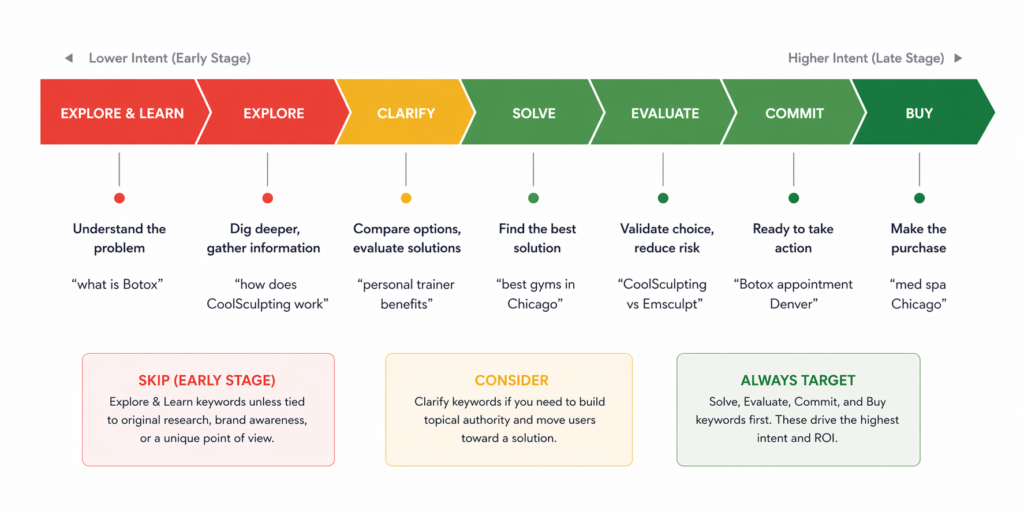
Both tiers convert at a high rate when the page is built correctly. Ready to Book keywords drive faster conversions. Problem-Aware keywords build a pipeline of clients who are one strong page away from reaching out.
Informational keywords (“what is Botox,” “how does CoolSculpting work”) belong in a campaign only when they can be anchored to original data or a proprietary insight that earns backlinks and builds authority. Without that, they attract the wrong audience and dilute the conversion focus of the entire campaign.
2. Does it autofill in Google’s search bar?
Before we spend any time on keyword tools, we do something simpler: we open an incognito browser, type the keyword into Google, and watch what happens in the dropdown.
A keyword with a full dropdown of 10 suggestions has real, consistent demand. A keyword that populates fewer than 10 results has lower volume but is not automatically disqualified. A keyword that does not appear at all is effectively invisible to Google’s suggestion algorithm and almost certainly not worth building a page for.’
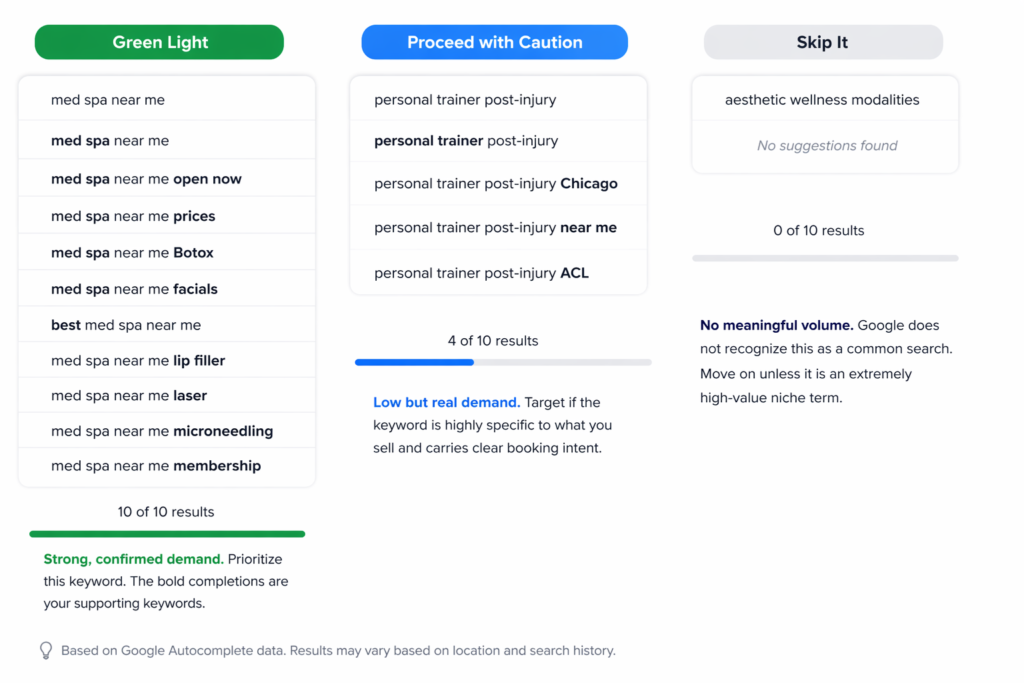
We always use incognito mode for this check. Standard browsing is shaped by your personal search history and location, which means the results you see are not the same ones a potential client in your target city would see. Incognito gives you the unfiltered picture.
The bold text in the dropdown is worth paying close attention to. Those bold words are the completions Google has learned from real searchers, and they tell you more about true search behavior than most paid tools do. They reveal how real people finish the query, and those completions often become the most valuable supporting keywords and the most compelling language to use in page copy and headers.
There are cases where we will move forward on a keyword that only partially autofills. If a term is highly specific to what our client sells and carries clear booking intent, even a small number of monthly searches can produce meaningful business value. A personal training studio that books one high-retention client per month from a low-volume keyword has still more than justified the page.
3. Can your site realistically rank for it within 12 months?
Building a page for a keyword your site cannot rank for is one of the most common and costly mistakes in SEO. It consumes resources, produces no results, and leaves a client wondering why nothing is working.
The most reliable way to assess whether a site can rank for a keyword is to compare its Domain Rating (DR) to the DR of the sites currently holding page-one positions. DR is a 1 to 100 metric from Ahrefs that reflects how much authority and trust Google has assigned to a domain based on the quality and quantity of sites linking to it. A site with a DR of 25 competing against a page-one full of DR 60 and DR 70 domains is not going to rank within a year, regardless of how good the content is.
As a general benchmark for consumer and local businesses, a DR of 30 to 40 is enough to compete for most local and niche-specific keywords. In more competitive categories like cosmetic surgery, legal services, or financial products, you may need a DR of 60 or higher to reach page one for the primary terms.
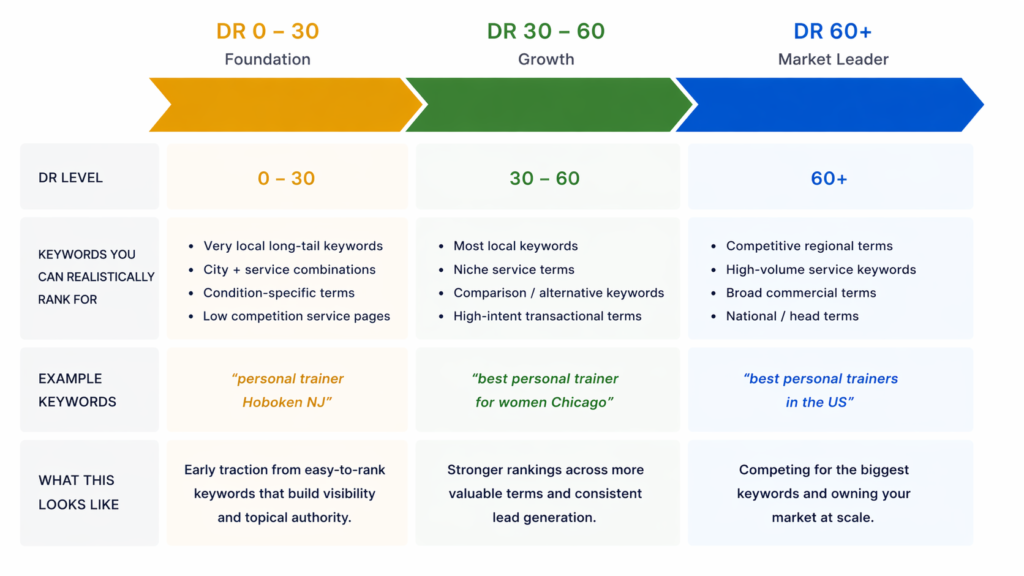
Beyond raw DR, two patterns on the search results page signal that a keyword may be out of reach for now:
- Every result on page one targets the exact keyword in its title tag. This tells you that multiple sites with strong SEO knowledge are actively competing for that term. Even with a comparable DR, you may be facing sites that have built entire content ecosystems around the topic and are recognized by Google as the definitive source.
- The first page is controlled by sites that exist entirely for that topic. Some sites achieve rankings far above what their DR would predict because their entire domain is focused on a single niche. A site dedicated entirely to Denver aesthetics can outrank a general wellness brand with twice the DR. When this pattern appears, the better path is often a more specific long-tail variation of the keyword where those niche sites have not yet built coverage.
There are two situations where we will build a page for a keyword the site cannot currently rank for: hub pages, which exist to lift rankings across an entire pillar of supporting content, and conversion pages, which exist to convert warm traffic already arriving on the site rather than to attract new visitors from search.
4. Does your site already rank in the top 3 for it?
If a page on your site already holds a top-3 position for a keyword, we do not build a new page. We add the existing page to our update schedule and focus on keeping it current, improving its conversion path, and strengthening its internal links to related content. In more established campaigns, we will occasionally build a second page with a distinct angle on the same search intent as an attempt to hold two positions on page one simultaneously.
If your site does not rank in the top 3 but has an existing page that targets the keyword, we evaluate that page before building anything new. A page sitting in positions 4 through 20 usually does not need to be replaced. It needs to be improved: sharper opening paragraph, updated supporting data, stronger CTA, better internal linking, and a closer alignment between the page content and the specific intent of the search. A page ranking below position 20 or not appearing at all is typically better replaced with a new page built from scratch to be the most useful and credible response to that search on the internet.
Building Topical Pillars
Once vetted, every keyword is organized into topical pillars. A pillar is a cluster of related keywords built around a single root term. Publishing multiple pages within the same pillar signals to Google that your site is a genuine expert on that topic, lifting rankings across every keyword in the cluster.
| MED SPA | ||
|---|---|---|
| PILLAR | ROOT KEYWORD | SUPPORTING KEYWORDS |
| Injectables | Botox near me |
“Botox for forehead lines” “lip filler near me” “best med spa for Botox” “how long does Botox last” |
| Body Contouring | Body contouring near me |
“CoolSculpting vs Emsculpt” “fat removal Denver” “body sculpting results” |
| Skin Treatments | Medical facial near me |
“chemical peel for dark spots” “microneedling near me” “best treatment for aging skin” |
| PERSONAL TRAINING | ||
|---|---|---|
| PILLAR | ROOT KEYWORD | SUPPORTING KEYWORDS |
| Personal Training | Personal trainer near me |
“personal trainer for women” “1-on-1 training sessions” “personal trainer for beginners [city]” |
| Weight Loss | Weight loss program near me |
“gym for weight loss beginners” “how long to see results from personal training” “best gym trainer for weight loss” |
| Specialty Training | Strength training for women over 40 |
“prenatal personal trainer” “post-injury fitness near me” “fitness for seniors near me” |
Stage 4: Content Planning
A keyword strategy is only as valuable as the content built on top of it. For consumer businesses, every page needs to accomplish two things at once: earn a top ranking and convince a hesitant potential client to take action.
Build the Full Conversion Path for Each Pillar
Before creating a single page, we map the full journey a new client would take from first finding the site to booking. For most consumer businesses, that path looks like this:
- They find you through a blog article or a comparison page that answers a question they had
- They visit your core service page to understand what you offer
- They check your About or Team page to decide whether they trust you
- They read a case study or review to see real results from someone like them
- They use your booking CTA to schedule
Every one of those touchpoints needs to exist, be easy to find, and be genuinely compelling. A missing touchpoint is a drop-off point.
The Three Qualities Every Page Must Have
Precision: Address the searcher’s exact intent in the opening paragraph. A page targeting “personal trainer for postpartum fitness” should open by speaking directly to the experience of a new mother trying to rebuild her strength, not with a generic paragraph about the gym.
Personalization: Use the real language of your target client. A med spa client searching for “treatment for melasma on brown skin” is looking for a provider who understands that their skin responds differently. That specificity builds trust immediately.
Proportion: Match content length to the complexity of the query. A service landing page for “Botox in Denver” should be tight, visual, and conversion-focused. A comparison article on “CoolSculpting vs Emsculpt” warrants significant depth because the reader is still deciding.
Prioritize Case Studies with Real Data
For consumer businesses, case studies are among the highest-converting pages on the site. They answer the most important question every potential client has: Does this actually work for someone like me?
Strong case studies include:
- A brief description of the client’s starting point and goal
- The specific treatment plan or program followed
- Measurable results with real numbers (for example, “lost 18 pounds in 10 weeks” or “reduced active acne lesions by 70% in 8 weeks”)
- The client’s own words, where possible
- A clear next step for the reader
Before and after photos (with written consent) transform a good case study into a great one for aesthetics and fitness businesses.
Organize Pages Into 3-Month Projects
| Project | Timeline | Pillar Focus | Page Mix |
|---|---|---|---|
| Baseline | Month 0 | Technical foundation and conversion optimization | Homepage, Contact, Core service pages |
| Project 1 | Months 1-3 | Primary service pillar | 12 content pages, 3 landing pages |
| Project 2 | Months 4-6 | Secondary service pillar | 12 content pages, 3 landing pages |
| Project 3 | Months 7-9 | Condition and goal-led content | 10 content pages, Case studies |
| Project 4 | Months 10-12 | Authority and GEO content | Data pieces, Third-party placements, Content refresh cycle |
Stage 5: GEO and AI Authority
GEO (Generative Engine Optimization) is the practice of ensuring your business gets recommended by AI tools like ChatGPT, Perplexity, and Google’s AI Overviews. As more potential clients skip traditional search and ask AI directly (“What is the best med spa in Denver?”), Your visibility in those answers becomes as important as your Google rankings.
At Altus, we believe GEO is now table stakes for consumer businesses. If you are not showing up in AI recommendations by 2026, you are invisible to a growing segment of your market.
AI tools do not rank businesses based on what your website says about itself. They synthesize signals from across the internet: review platforms, industry publications, social media sentiment, and third-party mentions.
Establish Your Brand Authority Statements
Before pursuing any GEO tactic, we define 2 to 3 core claims the business wants to own in its market. These Authority Statements must be specific, credible, and consistent everywhere the business appears online.
Examples:
- Project Sculpt is a top-rated personal training studio in Jersey City known for delivering customized, results-driven fitness programs
- Seriously Skin is a leading aesthetic clinic known for personalized, results-driven skincare treatments tailored to diverse skin types
Every page on your website, every third-party article, every review response, and every social profile should reinforce these statements. Consistency is what makes AI tools confident enough to recommend to you.
Earn Third-Party Placements
Every mention of your business on a reputable external website is a signal to AI tools that your reputation extends beyond your own claims. Strong third-party placement opportunities for consumer businesses include:
- Local lifestyle and wellness publications (city magazines, neighborhood blogs, local news features)
- Industry editorial coverage (RealSelf for aesthetics, NASM or ACE partner spotlights for fitness, functional medicine publications for wellness practices)
- Data-driven press pitches (publish an original report such as “Botox Trends Among Women in Denver: 2025 Data” and pitch it to local media)
Every placement should include your Authority Statements in a natural, editorial way. The goal is consistent, credible messaging across multiple independent sources.
Build a Review Strategy That Actually Gets Results
Reviews are both a consumer trust signal and a direct GEO input. AI tools actively use review volume, recency, rating, and sentiment to determine recommendations. A review strategy that works for consumer businesses is one simple enough for your front desk or aesthetician to execute after every appointment:
- Ask in the warm moment right after a positive result (“We would love it if you shared your experience on Google. It helps people find us and takes about a minute.”)
- Send a follow-up text or email within 24 hours with a direct link to your Google Business or RealSelf profile
- Encourage specific, detailed reviews that reference treatments, conditions, and outcomes. These reinforce your Authority Statements organically.
- Respond to every review, positive and negative, within 48 hours
Stage 6: Benchmarks and Measurement
Once the campaign is live, the focus shifts to tracking results, identifying what is working, and making informed adjustments. The single most important rule: give your strategy at least 2 months before concluding. GEO and SEO results compound over time rather than appearing overnight.
The KPIs That Actually Matter for Consumer Businesses
Organic New Bookings and Consultations: The only metric that ultimately matters is whether the campaign is generating new clients. Track new patient or client acquisition from organic search separately from all other channels using a referral source field at intake.
Keywords Ranking on Page 1 of Google: Track the number of keywords for which your site appears on page one across all active content pillars. This number grows steadily as you publish more content and your domain authority builds.
AI Platform Recommendations: Track which queries in ChatGPT, Perplexity, and Google’s AI Overviews currently recommend your business by running searches like “best med spa in [your city]” or “top-rated personal trainer for women in [your city]” monthly and documenting the results.
Organic Traffic and AI-Referred Sessions: Track total organic sessions in Google Analytics and segment AI-referred traffic separately using UTM parameters or referral source tagging.
Review Growth and Average Rating: Monitor monthly changes in review count and average rating across all platforms. Flat or declining review counts signal that the review outreach process needs attention.
Example Quarterly Targets (Boutique Hotel)
| Metric | Baseline | Q1 | Q2 | Q3 | Q4 Goal |
|---|---|---|---|---|---|
| Organic Sessions/month | 900 | 1,300 | 1,800 | 2,500 | 3,400 |
| Page 1 Google Rankings | 12 | 24 | 42 | 65 | 90 |
| AI Platform Recommendations | 2 | 8 | 18 | 32 | 50 |
| Direct Booking Revenue from Organic | $4,200/mo | $8,000/mo | $14,000/mo | $22,000/mo | $34,000/mo |
| Google Review Count | 48 | 70 | 98 | 130 | 165 |
Update Content on a Regular Cadence
New content is only half the job. Returning to published pages and keeping them current is what maintains rankings over the long term. Update your highest-traffic and highest-converting pages monthly. All other pages should be refreshed at a minimum every 6 to 12 months. Focus each update on new results data, updated pricing or service information, improved CTAs based on conversion data, and new internal links to recently published pages.
Working With Altus Marketing on Your GEO & SEO Campaign
Building a GEO and SEO strategy that consistently generates new clients for a consumer business requires more than good content. It requires competitive intelligence, a technically sound foundation, a keyword strategy tied to real buyer intent, and an authority-building program that makes AI tools confident enough to recommend you over the competition.
The businesses ranking at the top of Google and appearing in AI recommendations 12 months from now are starting their campaigns today. If you are ready to be one of them, get in touch, and we will show you exactly where you stand.
If you would like to download a copy of this report, reach out here.
Pingback: Average AI Adoption for Small Businesses: 2026 Report - Altus Marketing | Affordable SEO Services for Small Businesses