More customers now ask ChatGPT for recommendations before they search anywhere else. There is no paid placement or secret trick for appearing in its answers: OpenAI says ChatGPT ranks search results using multiple factors and that placement is not guaranteed. What you can control is whether your business is easy to find, easy to verify, and well regarded across the web. These 9 steps cover that work.
What Influences ChatGPT Answers
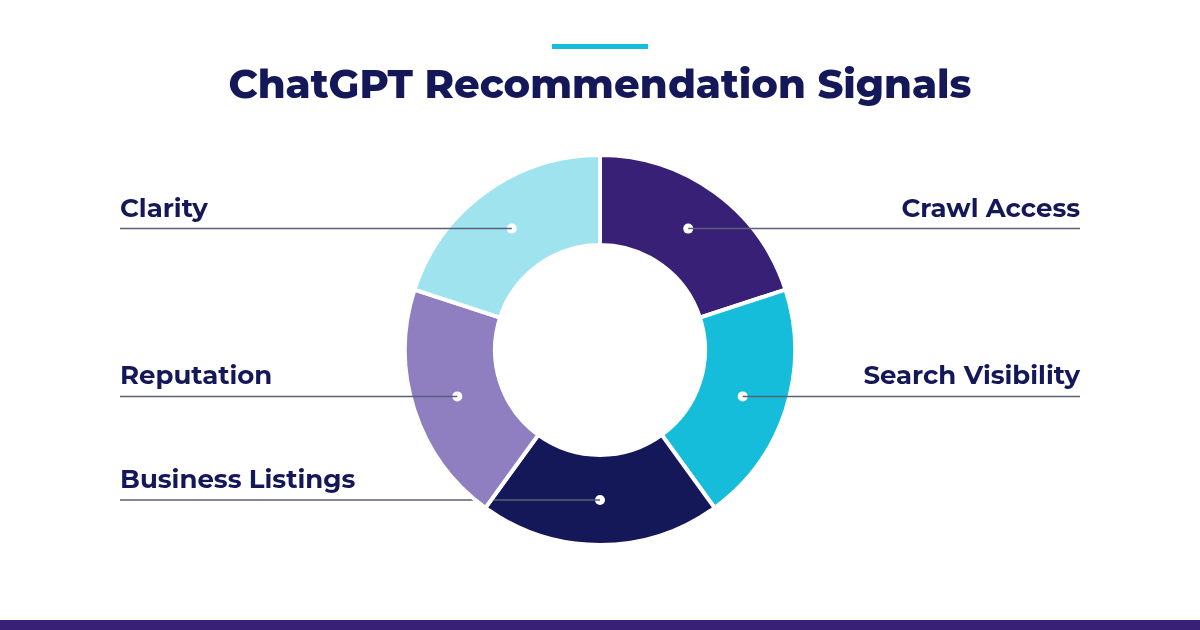
| Signal | What it means | Your lever |
|---|---|---|
| Crawl access | OAI-SearchBot can reach your pages | robots.txt and CDN settings |
| Search visibility | Your pages are indexed and rank in search engines | SEO on Google and Bing |
| Business listings | Accurate local data from listing providers | Consistent profiles everywhere |
| Reputation | Reviews and mentions on trusted sites | Review requests, PR, outreach |
| Clarity | Pages plainly state service, place, and audience | Clear on-page copy |
The 9 Steps
1Let ChatGPT’s search crawler in
OpenAI says that to be eligible for ChatGPT search results, a site must allow OAI-SearchBot to crawl it and its host or CDN must allow OpenAI’s published IP addresses. Check robots.txt and firewall rules. Blocking GPTBot (used for training) does not block OAI-SearchBot; the two are controlled separately.
2Build strong search fundamentals, on Google and Bing
OpenAI says ChatGPT search sometimes sends rewritten queries to third-party search providers, and its help page points to Microsoft’s privacy statement. Pages that are indexed and rank well in traditional search engines are easier for ChatGPT to find. Verify your site in Bing Webmaster Tools as well as Google Search Console.
3Write pages that match how customers ask
ChatGPT often rewrites a question into a short search query, such as “top restaurants San Francisco” in OpenAI’s own example. Make sure your service pages clearly name the service, the city or area, and the type of customer, in plain words a search query would use.
4Keep your business listings complete and consistent
For local questions, OpenAI says ChatGPT may use approximate location and trusted third-party providers for nearby business listings. Keep your name, address, phone, hours, and categories identical on your Google Business Profile, Bing Places, Apple Business Connect, Yelp, and industry directories.
5Earn reviews on the platforms your customers use
Ask happy customers for reviews on the sites that matter in your industry: Google and Yelp for most local services, and platforms like Clutch or G2 for B2B services. Respond to reviews and never pay for or gate them.
6Get mentioned on reputable sites
Local news coverage, industry associations, expert interviews, and genuine “best of” lists from independent publishers put your name on pages search engines already trust. Ask to be considered for relevant roundups, but avoid pay-to-play lists that don’t evaluate anyone.
7Make your expertise and claims checkable
Add author bios, case examples you are allowed to share, and links to sources for any figures you publish. OpenAI warns users that search results can be incomplete or outdated and encourages checking authoritative sources, so clear, sourced pages are the kind worth citing.
8Keep important pages current
Review key service pages and guides regularly, update outdated details, and show a visible last updated date when you make real changes. Don’t change dates without changing content.
9Track results with a prompt bank
There is no ChatGPT equivalent of Search Console. Write 10-20 questions your customers would ask, test them in ChatGPT each month, and record whether your business appears, how it is described, and who appears instead. In Google Analytics, watch referral traffic from chatgpt.com.
FAQ
Can I pay to rank on ChatGPT?
No organic placement is for sale. OpenAI says ChatGPT ranks results using multiple factors and placement is not guaranteed.
Does blocking GPTBot hide me from ChatGPT search?
No. GPTBot is for training and OAI-SearchBot is for search. You can block one and allow the other.
Is ranking on ChatGPT separate from SEO?
Largely no. ChatGPT search relies on web search results, so the same work that makes you findable in search engines supports ChatGPT visibility.
How long does it take?
There is no published timeline. Crawl access and listing fixes can matter quickly; reputation and reviews build over months. Track progress with a monthly prompt bank.
Do I need FAQ or HowTo schema?
Not for ChatGPT, which has published no schema requirement. On Google, FAQ rich results have been limited to government and health sites since 2023 and How-to rich results are deprecated.