Last updated: July 14th, 2026
Most businesses see their first MQL from SEO within three to six months. Before that, within the first two months of a campaign, you should see measurable improvements in organic traffic, backlink growth, domain rating, and keyword rankings. Those early signals confirm the strategy is working before pipeline results arrive. The realistic window for meaningful, compounding growth is four months to a year, and businesses that commit to that full timeline average an 86% reduction in cost per lead compared to paid advertising. Plan for it from the start, and SEO becomes one of the strongest returns on marketing spend available to a small business. Expect results in the first few weeks, and you will call it a failure before it ever has the chance to work.
This guide covers what actually happens month by month, what determines how fast your site moves, and how to track the ROI building before it becomes visible in your pipeline.
- What the realistic SEO timeline looks like, month by month
- The business outcomes to expect at each phase
- The five factors that control how fast results come
- How to measure ROI before leads arrive
SEO Timeline: Phase-by-Phase Reference
| Phase | Months | What Happens | What to Measure |
|---|---|---|---|
| Foundation | 1-2 | Technical audit, keyword research, 12-month roadmap built | Crawl errors resolved, baseline rankings established |
| Launch | 2-3 | Optimized content published, on-page fixes deployed | Impressions rising in Google Search Console |
| Early Gains | 3-4 | Long-tail keywords begin moving up in rankings | Keyword position improvements, new page-one appearances |
| Momentum | 4-6 | Page-one visibility for low-competition terms | Organic traffic increases, lead form submissions |
| Progress | 6-9 | Mid-competition keywords climbing, traffic growing steadily | Leads and calls from organic search |
| Growth | 9-12 | Rankings stabilizing, compounding results appearing | Revenue attributed to organic traffic |
| Scale | 12+ | Full compounding effect, authority expanding across topics | ROI and cost per lead vs. paid advertising |
What the Timeline Actually Looks Like
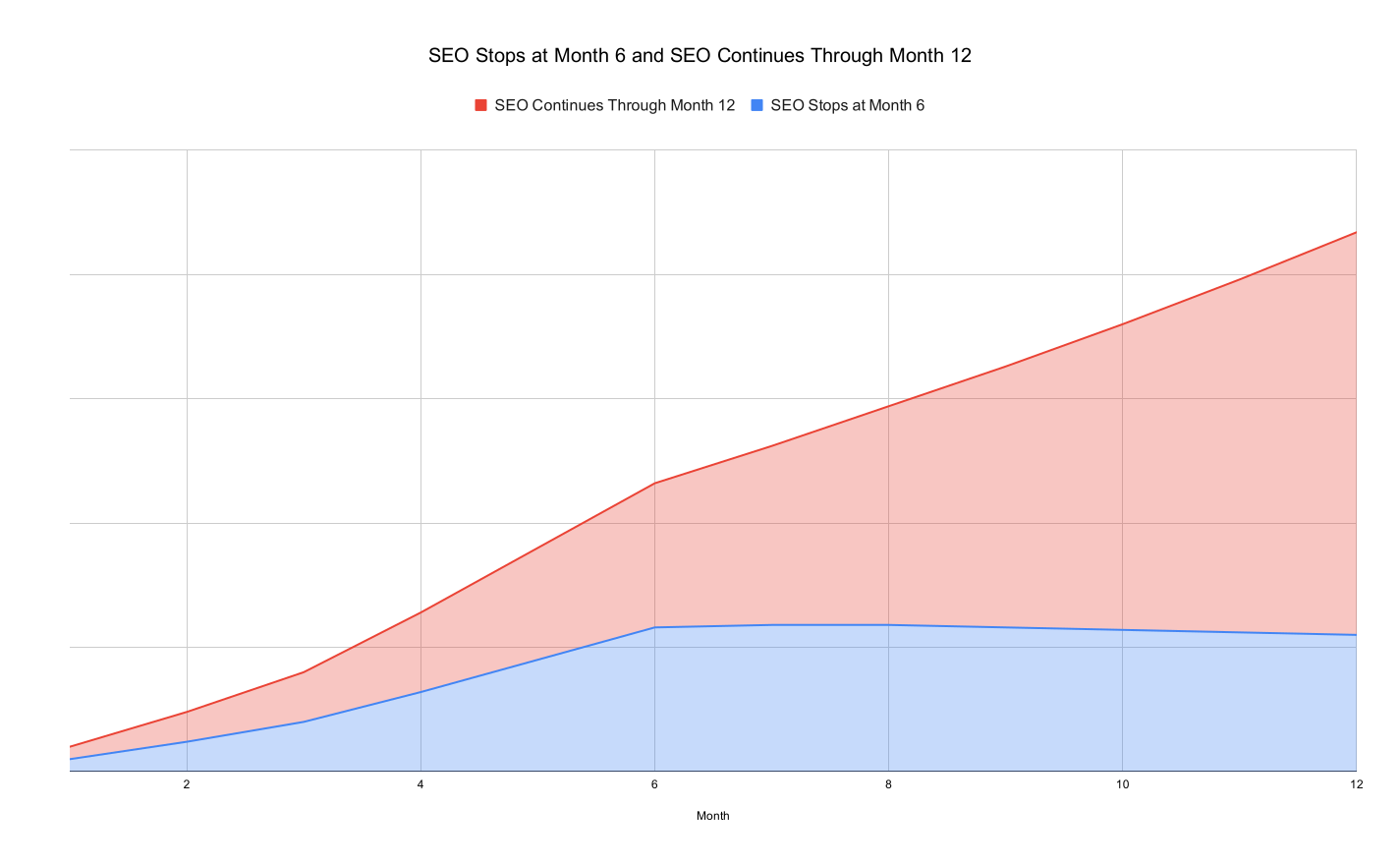
The four-to-twelve-month range is how the algorithm works. Google deliberately phases ranking changes over time rather than applying them all at once. Good SEO work done in month two may not fully show up in rankings until month four or five. The progress is real before it is visible, and understanding that is the difference between staying the course and pulling the plug too early.
Where you land within that range depends on where you are starting from. An established site in a less competitive local market will see results closer to the four-month mark. A brand-new domain in a saturated national category should plan for the full year. What stays consistent across both is the shape of the curve: slow at first, then accelerating sharply. The businesses that reach the compounding phase are the ones that treated the early months as an investment rather than a cost.
The SEO Timeline, Phase by Phase
Foundation Through Early Gains: Months One Through Four
The first two months are almost entirely about setup, and they are where the ROI ceiling gets determined. At Altus Marketing, month one means a full site audit, competitor analysis, research across 100 to 150 high-intent keywords, and a 12-month execution roadmap built around your specific market. By the end of month two, measurable signals should already be appearing: crawl errors resolved, baseline keyword rankings established, the first uptick in impressions in Google Search Console, and early backlink and domain rating movement. These metrics represent real infrastructure value being built, the kind that reduces dependence on paid acquisition over the following twelve months.
By months three and four, optimized content is live and long-tail keywords start climbing toward page one. These are the specific phrases that signal real buyer intent, terms like “commercial cleaning company in [city]” or “pediatric dentist near [neighborhood].” They carry lower search volume than broad terms but convert at a much higher rate, and they arrive before your competitors notice you are gaining ground. This is when the first organic traffic begins to replace the budget that would otherwise go to paid ads.
Momentum: Months Four Through Six
This is the phase where the first MQLs from organic search typically begin to arrive, driven by the long-tail and local terms that reached page one in the prior phase. The leads coming through are high-intent. They searched for exactly what you offer, found you organically, and converted without a dollar of ad spend behind them. That is the early proof of concept for what SEO delivers at scale.
Sites that push through this phase without stalling are the ones that see the sharpest compounding later. Businesses that stay consistent through this window average an 86% reduction in cost per lead compared to paid advertising by the end of a full engagement. The patience invested here is what separates businesses that scale organically from those that remain dependent on paid acquisition indefinitely.
Progress and Growth: Months Six Through Twelve
Mid-competition keywords reach page one, organic traffic grows month over month, and leads from search become a reliable part of the pipeline. At Altus Marketing, clients see an average of 95% organic traffic growth over nine months and 98% of targeted keywords reaching page one within eight months. By this stage, the cost per lead from organic is a fraction of what the same volume would cost through paid channels, and every month of consistency widens that gap further.
Scale: How Authority Changes What You Can Rank For
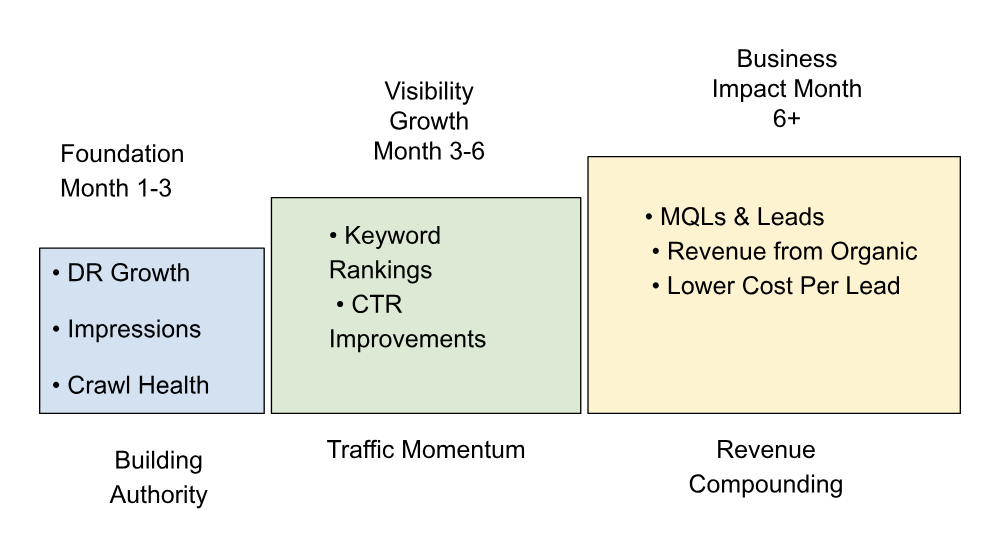
As a website’s authority grows, its ability to rank for higher-value SEO and GEO keywords improves significantly. Early-stage websites typically focus on foundational content like service pages, location pages, and lower-competition transactional keywords to establish topical relevance and generate initial leads. As authority, traffic, and keyword visibility increase, businesses can expand into more competitive comparison content, use case pages, and industry-focused resources that drive larger volumes of qualified traffic and AI visibility.
Over time, SEO and GEO become compounding assets. Higher-authority websites tend to generate substantially more organic traffic, ranking keywords, AI citations, and qualified inbound leads because they have stronger content depth, broader topical coverage, and more trust signals across the web. The long-term goal is to evolve from simply ranking for niche local terms to becoming a recognized market authority that consistently appears in both traditional search results and AI-generated recommendations.
The Five Factors That Control Your Timeline
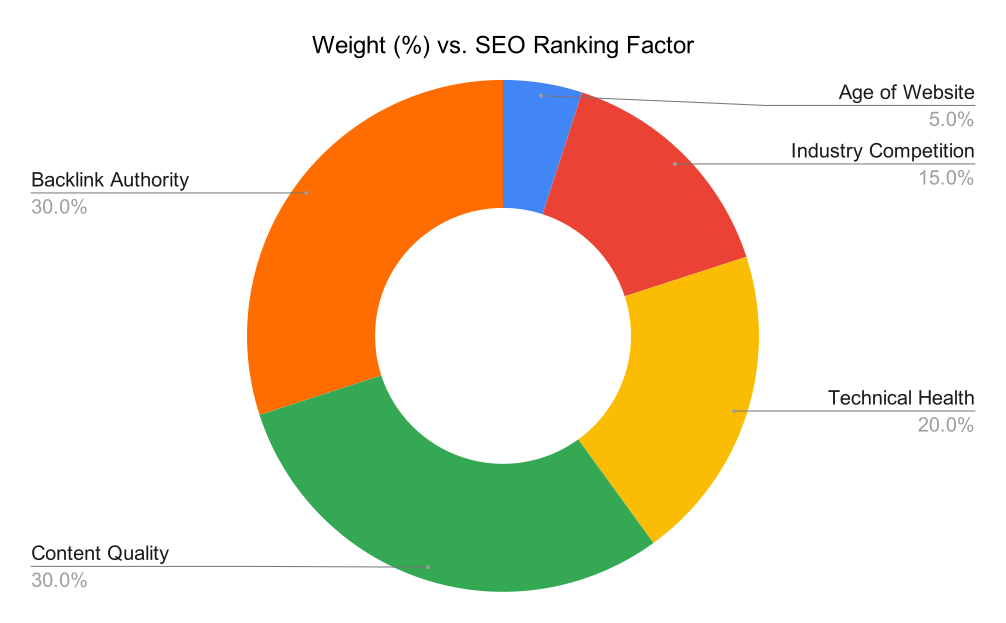
- Age of Website: How old your website is matters more than most people expect. An established domain with a backlink history and existing performance data ranks faster than a brand-new site. New domains go through an evaluation period where Google builds up trust signals gradually, which is why targeting long-tail and local terms in the early months is the right starting point for newer sites.
- Industry Competition: Competition in your industry determines how long it takes to displace whoever is already ranking above you. A local plumber in a mid-size city faces a much shorter path than a marketing agency competing in a major metro. Both can win with SEO, but the timelines differ, and knowing which situation you are in shapes how you set expectations and measure progress in the early months.
- Technical Health: Technical health determines how fast Google can find and evaluate your pages. Slow load times, broken internal links, and crawl errors delay the impact of every other effort. This is why month one at Altus Marketing is spent on an audit rather than content creation. A technically clean site translates directly into faster results and a shorter time to first MQL.
- Content Quality: Content quality determines whether rankings stick and whether the traffic that arrives converts. Thin pages with superficial answers plateau fast and attract the wrong visitors. Pages that genuinely address the questions buyers are searching for earn lasting positions, attract links over time, and drive the kind of qualified traffic that generates revenue rather than just sessions.
- Backlink Authority: Backlink authority builds gradually, and every link earned today makes the next piece of content more likely to rank faster and the next MQL less expensive to acquire. Quality links from authoritative, relevant sources raise your domain’s overall credibility and lift the ceiling for new pages as you add them.
How to Measure ROI Before Leads Arrive
Because major ranking shifts take three to six months to materialize, tracking only lead volume in the early stages creates unnecessary doubt. The right approach is to track leading indicators that represent real ROI being built, even before it converts to a pipeline.
In months one through two, track impressions in Google Search Console, pages indexed, crawl errors resolved, and domain rating movement. In months three through four, add keyword position movement and organic click-through rate. By month five or six, organic sessions to high-intent pages and contact form submissions from organic traffic should be trackable. Each of these metrics represents a reduction in what you would otherwise be paying to acquire the same visibility through paid channels. By month six, the cost-per-lead gap becomes directly visible, and by month twelve, the compounding effect makes that gap substantial.
| Phase | Months | KPIs to Track | What It Represents |
|---|---|---|---|
| Technical Foundation | 1-2 |
• Impressions (Google Search Console) • Pages indexed • Crawl errors resolved • Domain rating movement |
Real ROI being built before it converts to pipeline – visibility infrastructure in place |
| Early Visibility | 3-4 |
• Keyword position movement • Organic click-through rate |
Search visibility gaining traction – equivalent paid spend to achieve same rankings now trackable |
| First Conversions | 5-6 |
• Organic sessions to high-intent pages • Contact form submissions from organic • Cost-per-lead vs. paid channels |
Cost-per-lead gap becomes directly visible – organic leads vs. paid acquisition cost now comparable |
| Compounding ROI | 12+ |
• Total pipeline from organic • Cost-per-lead gap (organic vs. paid) • Revenue attributed to organic traffic |
Compounding effect makes the cost-per-lead gap substantial – full ROI picture clearly visible |
FAQ
What if I have been doing SEO for six months and see nothing? Inconsistency is the most common cause. SEO requires sustained execution across content, technical work, and link building. If any of those stalls, results stall with them. An audit of what was actually implemented versus what was planned will usually find the gap quickly.
Does a brand-new website take longer? Yes. New domains are evaluated more cautiously before Google awards competitive positions. A realistic expectation in a competitive market is twelve to eighteen months before significant traffic growth. Starting with long-tail and local terms builds traction faster and gets the first MQLs arriving sooner.
Can results be accelerated? The fastest path is resolving technical issues early, publishing thorough content consistently, and earning quality backlinks from relevant sources. Resources matter too: a team executing more work per month compresses the timeline and moves the first MQL window earlier.
How does the ROI of SEO compare to paid ads? Paid ads generate traffic immediately but stop the moment spending stops, and every lead carries a media cost. SEO builds compounding organic traffic that keeps growing without proportional cost increases. Altus Marketing clients average an 86% reduction in cost per lead from SEO compared to paid, after a full engagement, and that gap widens the longer the program runs.
Conclusion
SEO takes time because authority, trust, and relevance are built incrementally. The four-to-twelve-month window is accurate for most businesses. The ones that see the strongest results commit to the full timeline, track the right indicators at each phase, and stay consistent long enough to reach the compounding stage where organic traffic displaces paid spend at scale. Every month of consistent work raises the ceiling for what comes next.
To download a copy of this report, please reach out here.