Last Updated: July 14, 2026
GEO gets your business recommended by AI. AEO gets your content cited in AI answers. Both shape how your brand appears in the new search landscape, and understanding the difference tells you exactly where to spend your time.
The distinction matters more than most small business owners realize. When someone asks ChatGPT “what is local SEO,” AEO determines whether your blog post gets quoted in the response. When they ask “who is the best local SEO agency in New York,” GEO determines whether your business is the one ChatGPT names. These are two different problems with two different solutions, and mixing them up leads to a strategy with gaps.
Here is what this guide covers:
- What AEO and GEO each do and how they differ
- Which AI platforms each strategy targets
- The specific tactics behind each approach
- Where they overlap and how they reinforce each other
- Which one your small business should prioritize first
The GEO vs. AEO Comparison
AEO and GEO solve two different problems for your business. AEO makes your content the source AI uses when answering questions in your industry. GEO makes your business the name AI recommends when someone is ready to hire. For a small business trying to win clients, both roles matter, but they are built through different work.
What Is AEO?
AEO, or Answer Engine Optimization, is the practice of structuring your content so AI systems can extract and surface it as a direct answer to a user’s question. When someone asks Google’s AI Overview “how do I optimize my Google Business Profile” or asks Siri “what is local SEO,” AEO determines whether your content becomes the source AI uses to answer.
Traditional SEO focuses on driving clicks to your website. AEO is built around a different reality: AI answers questions directly, and users often get what they need without visiting any site at all. The goal shifts from ranking in a list to being the source inside the answer itself.
AEO matters because a growing share of informational searches now end in AI Overviews, featured snippets, or voice responses rather than clicks. Businesses whose content is clear, structured, and authoritative get cited in those answers. Businesses whose content is vague or disorganized get passed over.
The AEO Tactics Checklist
| Tactic | What It Does | Priority |
|---|---|---|
| FAQ sections | Answers common questions in a clear, extractable format AI can quote directly | High |
| Question-based headings | Frames H2 and H3 headings as the exact questions your audience asks | High |
| Answer-first writing | Places a direct answer in the first sentence of each section | High |
| FAQ schema markup | Tells AI systems exactly which parts of your page contain Q&A content | High |
| HowTo schema markup | Structures step-by-step content so AI can extract and present it as instructions | Medium |
| People Also Ask targeting | Creates content that answers the secondary questions Google surfaces below primary results | Medium |
| Voice search optimization | Writes in natural, conversational language that matches how people speak, not just type | Medium |
| Structured data (LocalBusiness, Article) | Gives AI additional context about your business, its category, and its content | Medium |
The highest-leverage AEO move for a small business is adding well-written FAQ sections to your service pages and blog posts, then backing them up with FAQ schema. These two steps together make your content far easier for AI systems to extract and surface.
What Is GEO?
GEO, or Generative Engine Optimization, is the practice of getting your brand cited and recommended inside AI-generated responses. When someone asks ChatGPT “who is the best marketing agency for small businesses in New York” or asks Perplexity “which SEO company should I hire,” GEO determines whether your business is the one AI recommends.
Where AEO focuses on making individual pieces of content easy for AI to extract, GEO focuses on making your entire brand visible and trustworthy in the eyes of AI systems. AI platforms decide who to recommend by looking at your reviews, third-party mentions, domain authority, and the consistency of your brand information across the web.
For small businesses, GEO represents a first-mover opportunity. Most competitors have never heard of it, let alone optimized for it. Getting your brand into AI recommendations before the rest of your market does builds a visibility position that compounds over time and grows harder to displace.
The GEO Tactics Checklist
GEO is built outside your website as much as on it. Reviews, brand mentions, and third-party recognition are the signals AI relies on most when deciding who to recommend. Start there, then reinforce with well-structured content on your site.
Where AEO and GEO Overlap
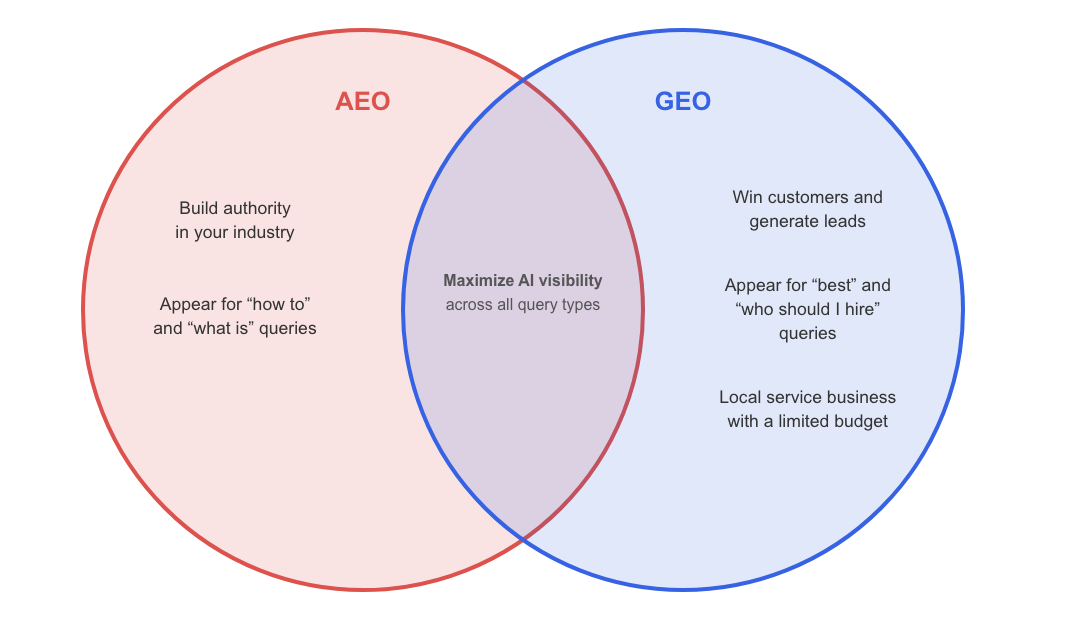
AEO and GEO are distinct in their goals, but many of the same tactics serve both. Well-structured content that answers questions clearly is easier for AI to extract (AEO) and signals the kind of authority that feeds brand recommendations (GEO). FAQ schema helps AI surface your content as a direct answer and helps AI understand your services well enough to recommend your business. The overlap is significant, which means strong content work moves both strategies forward simultaneously.
The clearest way to think about it: AEO is about your content, and GEO is about your brand. Both require the same underlying quality: clear, authoritative, well-organized information that AI systems can trust and repeat.
The AEO and GEO Overlap
The shared center of that diagram is where most small businesses should spend the majority of their effort. Tactics that advance both strategies simultaneously produce the best return on the time and budget you invest.
Which One Does Your Small Business Need?
For a small business trying to win customers, GEO typically delivers higher direct revenue impact. When someone is ready to hire, they ask AI for a recommendation, and GEO determines whether your business gets named. AEO wins visibility for informational queries, which builds authority over time but generates fewer direct leads in the near term.
That said, AEO and GEO work best together. AEO builds the content authority that feeds GEO. A brand that consistently appears as a cited source in informational answers is a brand AI starts to recognize as trustworthy, and that trust carries into recommendation queries. Running both strategies in parallel produces faster results than choosing one.
The AEO vs. GEO Priority Guide
The most important thing a small business can do is get clear on which type of query it most needs to win. Lead-generating businesses, including contractors, med spas, professional services, and retail, benefit most from GEO because the queries that produce revenue are recommendation queries. AEO then builds the authority structure that makes GEO more effective over time. For the full campaign framework that brings both together, Altus Marketing’s SEO & GEO Campaign Strategy Playbook lays out the step-by-step approach.
If you’d like to request a PDF copy of this report or learn more about our agency, you can reach out here.