Last Updated: July 14th 2026
SEO is the science of ranking on Google. GEO is the science of getting recommended by AI. Both matter in 2026, and understanding the difference tells you exactly where to put your marketing time and budget.
The way customers find businesses has changed. A growing share of your potential clients skip the search results page entirely. They type a question into ChatGPT, ask Perplexity for a recommendation, or read the AI Overview at the top of Google before they ever reach a link. A strategy built on SEO alone leaves that audience unreached. A GEO strategy built without SEO as a foundation will underperform. The businesses winning in 2026 are doing both, and they are building them together.
Here is what this guide covers:
- What SEO and GEO each do and how they differ
- Which platforms does each strategy target
- The specific tactics behind each approach
- How the two strategies reinforce each other
- Where to start based on where your business stands today
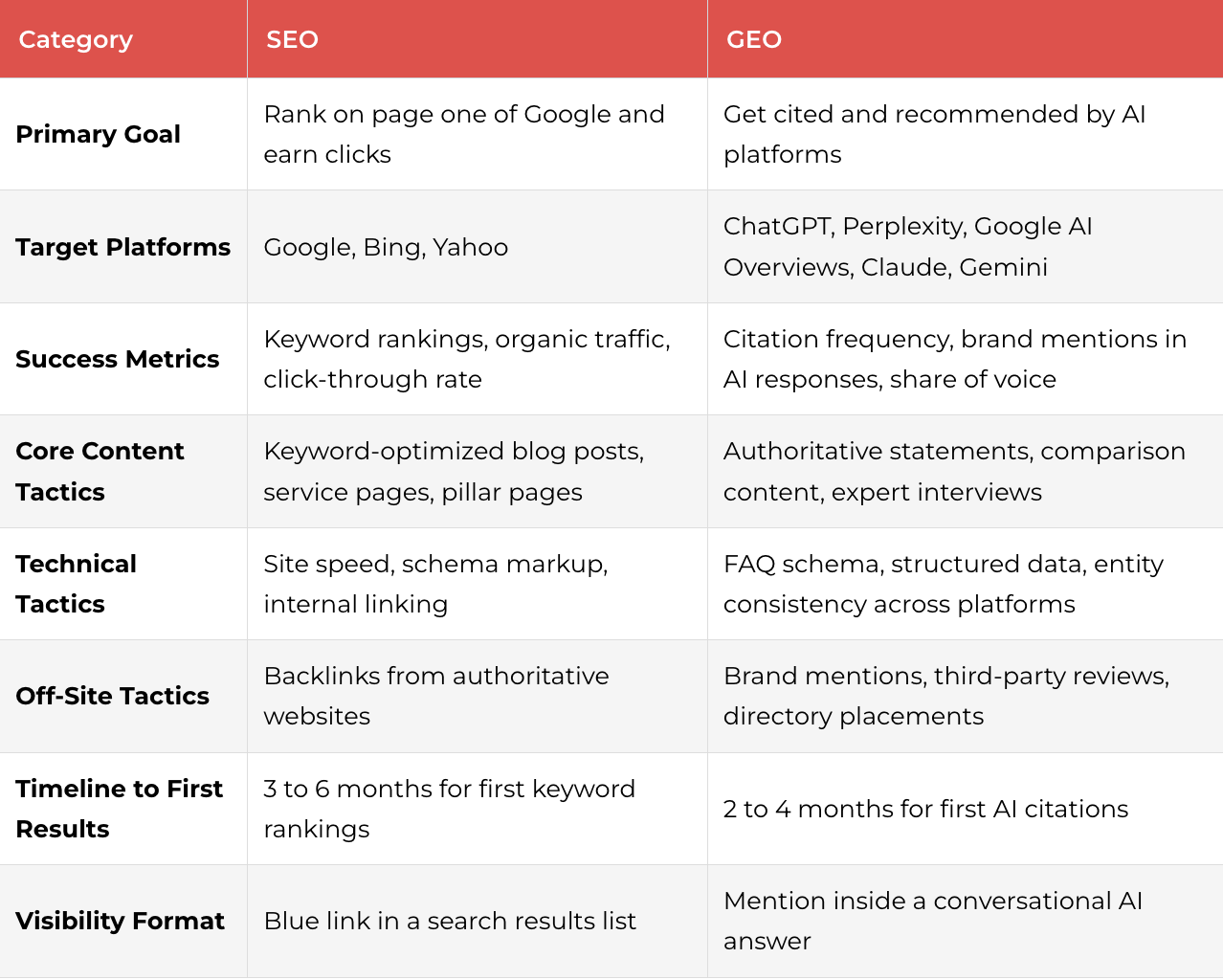
The GEO vs. SEO Comparison as of 2026
| Category | SEO | GEO |
|---|---|---|
| Primary Goal | Rank on page one of Google and earn clicks | Get cited and recommended by AI platforms |
| Target Platforms | Google, Bing, Yahoo | ChatGPT, Perplexity, Google AI Overviews, Claude, Gemini |
| Success Metrics | Keyword rankings, organic traffic, click-through rate | Citation frequency, brand mentions in AI responses, share of voice |
| Core Content Tactics | Keyword-optimized blog posts, service pages, pillar pages | Authoritative statements, comparison content, expert interviews |
| Technical Tactics | Site speed, schema markup, internal linking | FAQ schema, structured data, entity consistency across platforms |
| Off-Site Tactics | Backlinks from authoritative websites | Brand mentions, third-party reviews, directory placements |
| Timeline to First Results | 3 to 6 months for first keyword rankings | 2 to 4 months for first AI citations |
| Visibility Format | Blue link in a search results list | Mention inside a conversational AI answer |
SEO and GEO are two different games, played on two different platforms, but built on the same foundation. Strong content, clear authority signals, and well-structured information help you win both. Use the table above to identify which side your current strategy covers, and which side still has gaps.
What Is SEO?
SEO, or Search Engine Optimization, is the practice of making your website visible in Google search results when someone types a query related to your business. When a potential customer searches “best plumber in Austin” or “how to choose a business accountant,” SEO determines whether your business appears on page one or gets buried below the competition.
The core mechanics of SEO come down to three things: the content on your website, the technical structure of your site, and the authority signals you build off-site. Content tells Google what you do. Technical SEO tells Google your site is reliable. Backlinks from other websites tell Google your business is worth trusting.
SEO has been the cornerstone of digital marketing for over two decades, and it still produces measurable results. Businesses that rank on page one for high-intent keywords generate a consistent, compounding stream of organic leads without paying for each click.
The SEO Tactics Checklist
| Tactic | What It Does | Priority |
|---|---|---|
| Keyword research | Identifies the exact phrases your customers type into Google | High |
| On-page optimization | Aligns page titles, headings, and body content with target keywords | High |
| Technical audit | Resolves crawl errors, page speed issues, and mobile problems that suppress rankings | High |
| Content production | Builds a library of pages that answer your audience’s questions | High |
| Backlink building | Earns links from authoritative websites to raise your domain rating | High |
| Internal linking | Connects pages so Google understands your site’s depth and structure | Medium |
| Schema markup | Adds structured data that helps Google categorize your content | Medium |
| Local SEO | Optimizes your Google Business Profile and location pages for map pack visibility | High (local businesses) |
Start with the High-priority tactics before building out the rest. Keyword research, on-page optimization, and backlink building form the foundation that every other tactic builds on. For businesses serving a local market, local SEO belongs at the top of the list alongside the others. A step-by-step framework for building your SEO campaign from the ground up.
What Is GEO?
GEO, or Generative Engine Optimization, is the practice of getting your business cited and recommended inside AI-generated answers. When someone asks ChatGPT, “Who is the best marketing agency for small businesses in New York?” or prompts Google’s AI Overview with “how do I improve my local SEO,” GEO determines whether your business appears in the response.
AI platforms decide who to cite based on a different set of signals than Google. They look for authoritative content, consistent brand identity across the web, strong reviews, third-party mentions, and structured information that is easy to extract and repeat. A business can have solid Google rankings and still be invisible in AI answers if these signals remain unbuilt.
GEO matters because search behavior is shifting. A growing share of high-intent queries now begin with a question typed into ChatGPT or Perplexity rather than a keyword typed into Google. Businesses that optimize for this shift capture leads that competitors relying on SEO alone will miss entirely.
The GEO Tactics Checklist
| Tactic | What It Does | Priority |
|---|---|---|
| Branded authoritative statements | Creates specific, quotable claims AI can extract and repeat | High |
| Comparison and “best of” content | Targets the exact query types AI uses when building recommendation lists | High |
| Review building (Clutch, Trustpilot, BBB, G2) | Provides third-party trust signals AI platforms heavily weight | High |
| Brand mention outreach | Places your business name on authoritative external sites | High |
| Entity consistency audit | Ensures your name, address, and description match across every platform | Medium |
| FAQ schema markup | Makes your content easy for AI systems to parse, extract, and cite | Medium |
| Expert interviews and Q&A placements | Creates citation-worthy mentions on high-authority sites | Medium |
| Awards and recognition pages | Builds a credibility reference point AI returns to repeatedly | Medium |
The highest-impact GEO moves are the ones that build trust signals beyond your own website. Start by getting your reviews in order on the platforms AI checks most often. Then focus on earning brand mentions and building branded, authoritative content directly on your site. A full breakdown of how to execute each of these tactics.
How SEO and GEO Work Together
SEO and GEO are often treated as separate strategies, but they reinforce each other at every level. AI platforms like ChatGPT and Perplexity draw from Google’s top search results as a primary source when generating recommendations. Your Google rankings feed your AI visibility directly. A business that ranks on page one for “best [service] in [city]” is already in a position to be cited when AI answers that same question conversationally.
The relationship runs in both directions. Building strong GEO signals produces better content: clearer, authoritative statements, more structured information, and deeper topical coverage. All of those improvements also lift Google rankings. Running both strategies together produces faster results than either one alone.
The GEO and SEO Overlap
| Tactic | Helps SEO | Helps GEO |
|---|---|---|
| High-quality blog content | Earns rankings and attracts backlinks | Gives AI something relevant to cite |
| Schema markup (FAQ, HowTo) | Improves rich results in Google | Makes content easy for AI to extract |
| Backlinks from authority sites | Raises domain rating | Signals brand credibility to AI platforms |
| Online reviews | Supports local search signals | Primary trust signal for AI recommendations |
| Entity consistency across platforms | Supports local and map pack signals | Helps AI form a confident picture of your brand |
| Structured service pages | Targets high-intent keywords | Gives AI clear, quotable service descriptions |
Think of SEO as building the foundation, and GEO as building your reputation on top of it. Every dollar you invest in strong content, technical structure, and external authority moves both strategies forward at the same time. For a deeper look at exactly how ChatGPT decides who to recommend.
Where to Start as a Small Business
Most small business industries are still in the early stages of GEO adoption. That means the window to get ahead of local competitors is open right now, and the businesses that move first will be hardest to displace once AI search becomes the norm. GEO is a first-mover advantage, and in most markets, it is still available for the taking.
But GEO requires a foundation. Before any GEO work begins, your website needs to be fully built out: every service clearly described, SEO-optimized pages in place, location pages live, and a strategic content plan already in motion. AI platforms decide who to cite by drawing on Google rankings and authoritative external signals. A weak foundation means GEO tactics will underperform.
The good news is that most of what you do for SEO directly serves GEO. Keyword-optimized service pages, well-structured blog content, schema markup, and consistent entity information all contribute to both. Adding GEO tactics on top of a solid SEO program is less additional work than most businesses expect, and the results from a combined strategy consistently outperform SEO alone.
The GEO Readiness Checklist
| Foundation Requirement | What “Ready” Looks Like | Why It Matters for GEO |
|---|---|---|
| Service pages | Every service has a dedicated, SEO-optimized page with clear descriptions | AI needs structured, specific content to cite your services accurately |
| Website structure | Clean site architecture, fast load times, mobile-optimized | Technical issues suppress Google rankings, which AI draws from directly |
| Keyword strategy | Target keywords identified and mapped to specific pages | GEO targets the same high-intent queries as SEO |
| Content plan | Blog content in production covering core topics in your industry | AI cites authoritative content libraries, not thin sites |
| Google Business Profile | Verified, complete, and actively managed | Primary signal for local AI recommendations |
| Review volume | 20 or more reviews across Google, Yelp, or industry platforms | AI heavily weights third-party trust signals |
| Entity consistency | Business name, address, and description match across all platforms | Inconsistency makes it harder for AI to confidently recommend your brand |
Once these are in place, GEO tactics layer on cleanly. The first-mover opportunity is real: most small businesses in your market have never heard of GEO, let alone optimized for it. Getting your brand into AI answers before competitors do builds a visibility position that compounds over time and is far harder to displace once established.
If you’d like to implement GEO strategies in your business and be the first to be recommended by AI in your industry, you can reach out here.