Last Updated: May 8th, 2026
Local SEO determines whether customers in your service areas find you or your competitors when they search for what you offer. Get it right, and you capture qualified leads in every city you serve. Get it wrong, and you’re invisible to thousands of potential customers actively looking for your services.
This guide shows you exactly how to build a local SEO strategy that works. You’ll learn how to optimize your Google Business Profile to appear in the Local Pack, create service area landing pages that rank, and structure your website so Google understands exactly where you operate and what you offer.
What you’ll learn:
- Why Google Business Profile optimization is the fastest path to local visibility
- How to create service area landing pages that rank without duplicate content penalties
- The two-pillar local SEO strategy that drives consistent leads
- Specific tactics to outrank competitors in every city you serve
- How to measure local SEO success and adjust your strategy
What Is Local SEO?
Local SEO is the practice of optimizing your website and online presence, so you appear when people search for services in specific geographic areas. It’s how a plumbing company in Phoenix shows up when someone searches “emergency plumber Scottsdale” or how an HVAC contractor ranks for “AC repair Gilbert AZ.”
Unlike traditional SEO that targets broad national keywords, local SEO focuses on geo-specific search queries. The strategy works because people prefer working with businesses that understand their specific area. Someone searching “roofing contractor Chandler AZ” wants a roofer familiar with Chandler’s building codes, weather patterns, and neighborhood characteristics.
Who needs local SEO:
Any service business serving customers in specific geographic areas benefits from local SEO. This includes:
- Home services (HVAC, plumbing, electrical, roofing, landscaping)
- Professional services (law firms, accounting, consulting)
- Healthcare (dental, chiropractic, physical therapy, med spas)
- Construction and contracting (remodeling, home building, solar installation)
- Local retail and specialty services
The Two Pillars of Local SEO Success
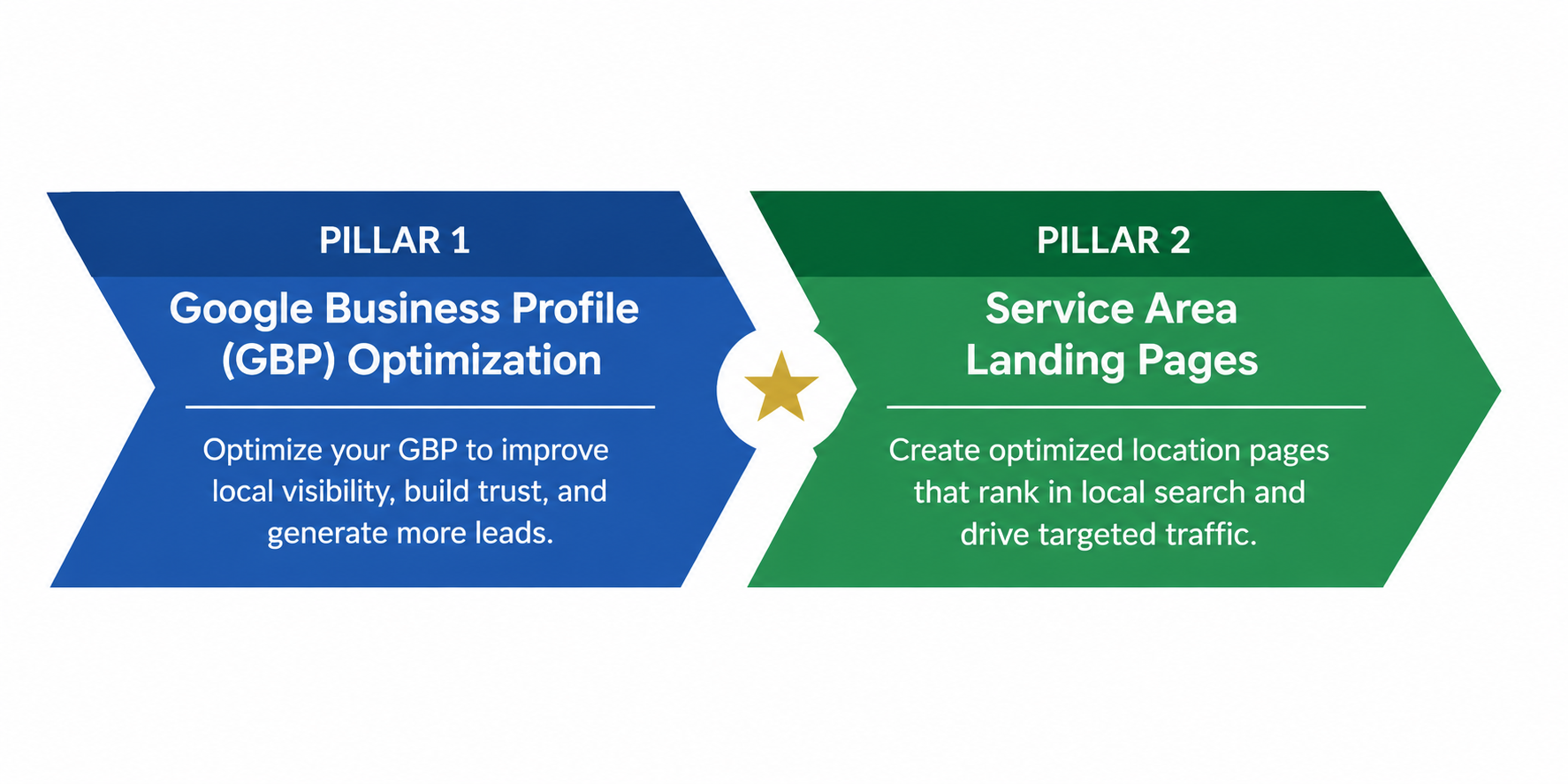
Effective local SEO requires two distinct but interconnected strategies. Think of them as two pillars supporting your local visibility. You need both to dominate local search.
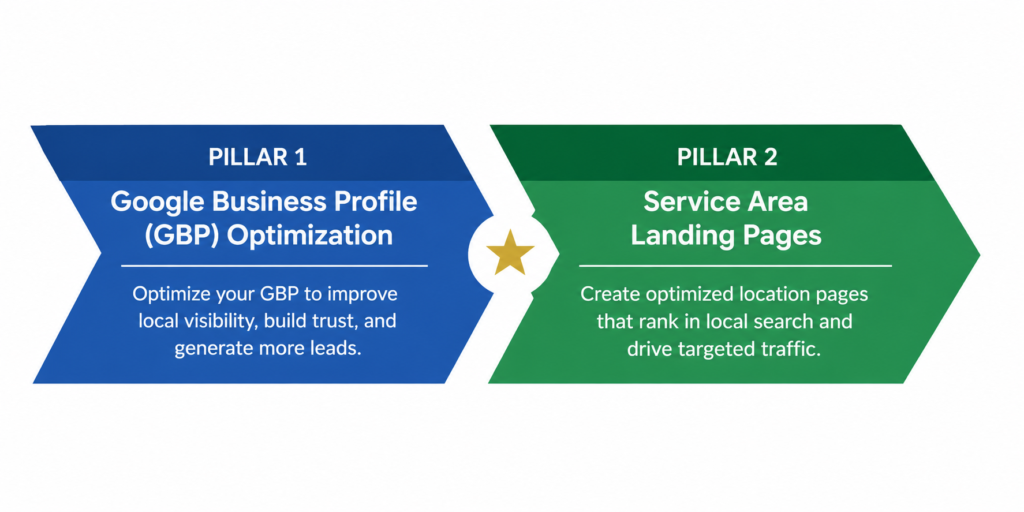
Pillar 1: Google Business Profile (GBP) Optimization
Your Google Business Profile is the single most important factor in local search visibility. When someone searches “[service] near me” or “[service] [city],” Google displays the Local Pack (the map with three business listings) above organic results. Appearing in this pack drives 60-70% of local clicks.
Why GBP matters more than anything else:
The Local Pack appears before organic search results. Even if you rank #1 organically, you’re below the three businesses in the Local Pack. Optimizing your GBP gets you into that prime real estate.
Google uses your Business Profile to determine local pack rankings. Factors include business category, proximity to location, review count and rating, post frequency, Q&A activity, and how completely you’ve filled out your profile.
Core GBP optimization tactics:
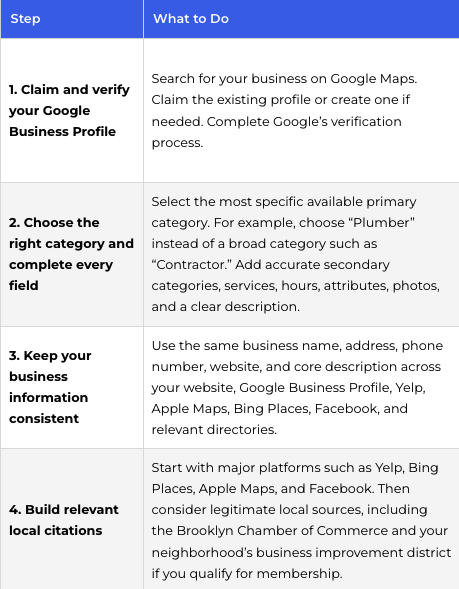
1. Complete every profile section
Don’t leave any field blank. Fill out business name, address, phone number (ensure NAP consistency across all platforms), website, hours, business description (use keywords naturally), services offered, and attributes (women-led, veteran-owned, etc.).
2. Choose the right primary category
Your primary category is the most important ranking factor for the Local Pack. If you’re an HVAC company, choose “HVAC Contractor”, not “Air Conditioning Contractor” or “Heating Contractor.” The primary category should match your main service.
Add secondary categories for additional services (Air Conditioning Repair Service, Furnace Repair Service), but prioritize getting the primary category exactly right.
3. Build and maintain reviews aggressively
Review count and average rating directly impact Local Pack rankings. Businesses with 50+ reviews dramatically outperform those with 10-20 reviews, even if the average rating is slightly lower.
Create a systematic review generation process. After completing a job, send a follow-up email or text with a direct link to your GBP review page. Make it one click to leave a review. Respond to every review (positive and negative) within 48 hours. Google rewards engagement.
4. Post weekly updates
Google Business Posts keep your profile active and give you another opportunity to include keywords. Post weekly updates about services, promotions, projects completed, or helpful tips. Posts appear in your Business Profile and signal to Google that your business is active.
5. Answer questions proactively
The Q&A section in your profile is often overlooked but valuable. Don’t wait for questions. Seed the section yourself with common questions customers ask: “Do you offer emergency services?” “What areas do you serve?” “Are you licensed and insured?”
Answer them with keyword-rich responses. This content gets indexed and helps with ranking.
6. Add high-quality photos regularly
Profiles with 100+ photos get 520% more calls and 2.7x more clicks than those with minimal images. Upload photos of completed work, your team, your vehicles, before/after shots, and your office or storefront.
Add photos weekly if possible. Consistent photo uploads signal an active, engaged business.
Pillar 2: Service Area Landing Pages
While your GBP handles Local Pack visibility, service area landing pages target organic rankings for “[service] [city]” searches. These pages ensure you appear in standard search results for every city you serve.
Why service area pages matter:
Google needs specific pages to rank for specific queries. If you serve 10 cities but only have one generic “Service Areas” page listing them all, you won’t rank well for any individual city. You need dedicated pages optimized for each location.
The duplicate content problem:
Most businesses create location pages by copying the same template and swapping the city name. This creates duplicate content, which Google penalizes. Your Phoenix page says, “We serve Phoenix with expert HVAC services,” and your Scottsdale page says, “We serve Scottsdale with expert HVAC services.” Everything else is identical.
Google sees this as thin, manipulative content and won’t rank these pages well.
How to create unique, ranking service area pages:
Each service area page must be at least 60% unique from every other page (excluding header and footer). This requires strategic planning, not just different city names.
The template structure that works:
Section 1: Geo-specific introduction (150-250 words)
Write a personalized introduction demonstrating you understand that specific city. Reference local characteristics, common problems in that area, neighborhood names, local landmarks, or unique aspects of serving that market.
Example for Phoenix: “Phoenix homeowners know summer temperatures regularly hit 115°F, which means your AC isn’t just a convenience, it’s essential for safety. Our Phoenix HVAC team understands the stress your system faces during brutal Arizona summers. We’ve serviced over 2,000 homes across Ahwatukee, Arcadia, and Desert Ridge, and we know exactly which AC issues plague Phoenix homes built in the 1990s versus newer construction in master-planned communities like Verrado.”
Example for Scottsdale: “Scottsdale’s luxury homes in neighborhoods like DC Ranch and Silverleaf require HVAC systems that deliver both performance and quiet operation. Our Scottsdale HVAC specialists understand that homeowners here expect premium service matching the caliber of their properties. We work with high-end systems from Carrier, Trane, and Lennox, and we’re familiar with the unique demands of cooling 4,000+ square foot homes with multiple zones.”
Notice these introductions are completely different. One focuses on heat, older homes, and safety. The other emphasizes luxury, quiet operation, and premium brands. Both are relevant to HVAC services but are uniquely tailored to each city’s characteristics.
Section 2: Rotating content modules (choose 3-4 per page)
Instead of having the same sections on every page, rotate different content modules across your location pages. This creates natural uniqueness.
| Content Module Options |
|---|
|
• Our Process: Step-by-step explanation of how service delivery works • Why Choose Us: Specific differentiators and company values • Meet the Team: Feature different team members on different pages • Local Case Study: Completed project in that specific city • Service Benefits: Different benefits highlighted per page • Customer Testimonials: Real reviews from customers in that city • FAQ: Different questions answered on each page • Did You Know? Interesting facts about your service or industry • Image Gallery: Photos of completed work in that city • Popular Services: Different service breakdowns per location • Certifications & Awards: Company credentials and recognition • Video Content: Embed different videos per page • Local Partnership: Feature a partnership with a local business or charity |
| Key Insight |
|---|
| Both pages cover HVAC services, but the supporting content is completely different. Google sees them as unique, valuable pages rather than duplicate content. |
Section 3: Strong call-to-action
Every service area page needs clear next steps. Include phone number, contact form, and specific calls-to-action like “Schedule Your Phoenix AC Inspection” or “Get a Free Quote for Scottsdale HVAC Installation.”
How Many Service Area Pages Do You Need?
Create one dedicated page for each city where you have a significant opportunity. Don’t create pages for tiny towns with 2,000 people unless you’re already dominating larger markets.
Prioritization framework:
Tier 1 (must-have pages): Cities with 50,000+ population where you actively serve customers or want to serve customers. Create these pages first.
Tier 2 (should-have pages): Cities with 20,000-50,000 population where you’ve completed projects or have an opportunity. Add these after Tier 1 is complete.
Tier 3 (nice-to-have pages): Smaller cities or neighborhoods within larger cities where you want additional coverage. Build these only after Tier 1 and 2 are ranking well.
| Optimal Number of Service Area Pages |
|---|
| For most service businesses, 8-20 service area pages cover primary markets effectively. A Phoenix-area contractor might create pages for: Phoenix, Scottsdale, Mesa, Chandler, Gilbert, Tempe, Glendale, Peoria, Surprise, Avondale, Goodyear, and Buckeye (12 pages total). |
Internal Linking Strategy for Local Pages
Service area pages should link to each other and to your main service pages. This helps Google understand your geographic coverage and distribute authority across local pages.
Create a service area hub page that lists all cities you serve with brief descriptions and links to each dedicated city page. This becomes your internal navigation center.
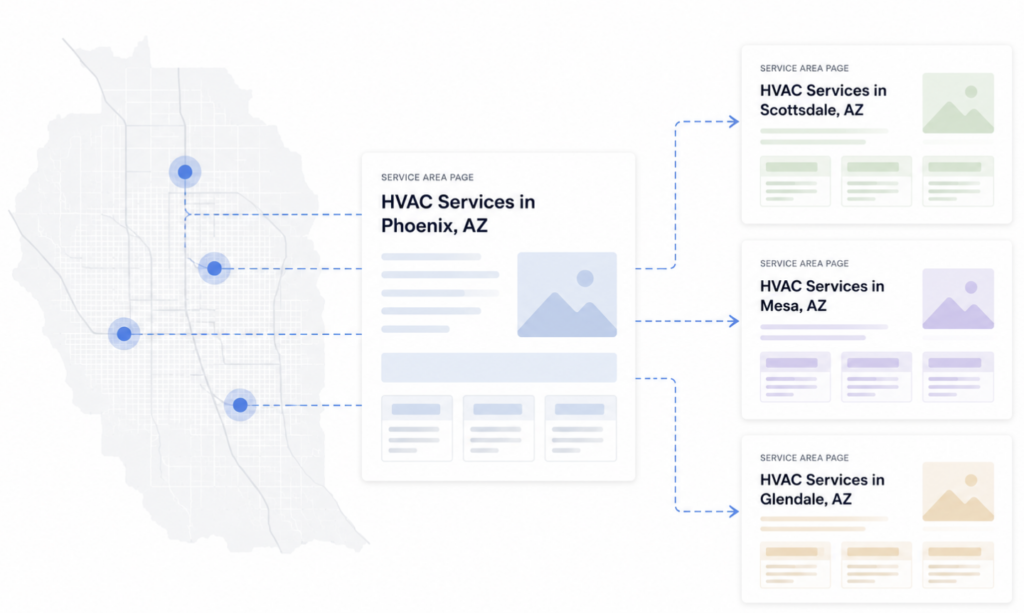
As you can see from each city page, link to 2-3 nearby city pages at the bottom: “We also serve [neighboring cities].”
Link from city pages back to your main service pages for cross-referencing: “Learn more about our [service name] or view our complete [service] guide.”
Technical Requirements for Local SEO Pages
URL structure:
| Use Clean URLs that Include the City and Service |
|---|
• yoursite.com/phoenix-hvac/• yoursite.com/scottsdale-hvac/• yoursite.com/mesa-air-conditioning/
|
Avoid parameters, dates, or unnecessary words in URLs.
Title tags:
| Create Unique Title Tags for Each Page that Include City, Service, and Brand |
|---|
|
• “Phoenix HVAC Services | AC Repair & Installation | [Your Company]” • “Scottsdale HVAC Contractor | Premium AC Services | [Your Company]” |
Meta descriptions:
| Write Unique Meta Descriptions (155-160 Characters) for Each Page |
|---|
|
Include the city name, key services, and a call-to-action: • “Phoenix’s trusted HVAC contractor. 24/7 emergency AC repair, installation, and maintenance. Serving Ahwatukee, Arcadia, and all Phoenix areas. Call now!” |
Schema markup:
Add the LocalBusiness schema to each service area page. Include business name, address (use service area schema if you don’t have a physical location in every city), phone number, service area, operating hours, and review aggregate data.
Mobile optimization:
Over 60% of local searches happen on mobile devices. Ensure your service area pages load in under 3 seconds on mobile, phone numbers are clickable, forms are easy to complete on small screens, and navigation is simple.
Content Creation Process for Service Area Pages
Creating 10-15 service area pages becomes much more manageable when approached through a structured content creation process. Each page should begin with research into the specific city or market, including local demographics, neighborhoods, common homeowner or business challenges, landmarks, and other characteristics that make the location unique. From there, pages should be strategically structured using a mix of different content modules, such as FAQs, case studies, process sections, or testimonials, while avoiding repetitive layouts across consecutive pages.
To maximize uniqueness and local relevance, each page should begin with a fully geo-specific introduction written specifically for that market. Content within modules should also be written independently rather than copied or lightly modified from other pages, helping prevent repetitive phrasing and duplicate content issues. Before publishing, pages should be reviewed to ensure strong differentiation from other service area pages, with a target of at least 60% unique content across the site.
Measuring Local SEO Success
Track these metrics monthly to evaluate local SEO performance:
| Metric Category | Key Metrics to Track Monthly |
|---|---|
| Google Business Profile Metrics |
• Profile views (monthly) • Search queries used to find your profile • Direction requests • Phone calls from profile • Website clicks from profile • Review count and average rating |
| Service Area Page Metrics |
• Organic traffic per city page • Keyword rankings for “[service] [city]” queries • Conversion rate (leads generated per city page) • Time on page and bounce rate |
| Overall Local Metrics |
• Total local pack appearances • Click-through rate from local pack results • MQLs generated from local searches • Cost per local lead |
What good performance looks like:
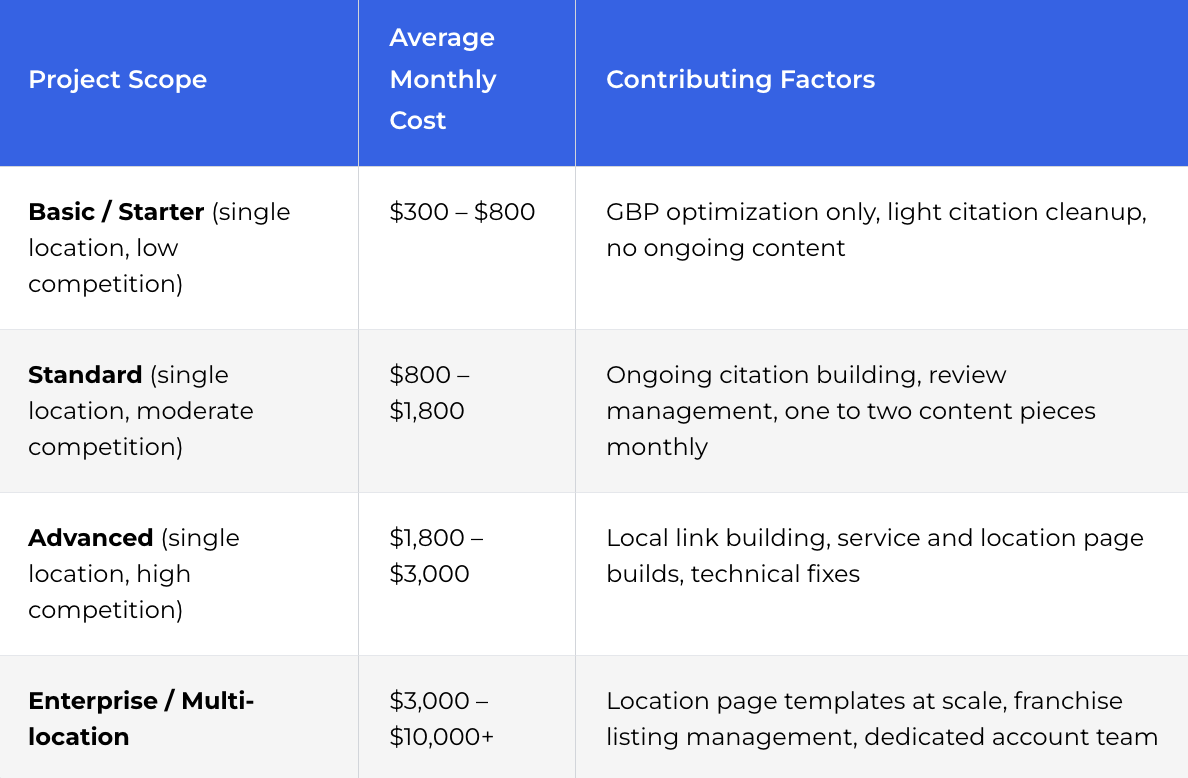
For an established service business investing $1,500-2,500 monthly in local SEO, expect these results within 12-18 months:
- GBP views: 2,000-5,000 monthly
- Local pack rankings: Top 3 for 8-15 primary keywords
- Direction requests: 50-150 monthly
- Service area page traffic: 100-400 visitors per page monthly
- Total local organic traffic: 2,500-6,000 monthly
- MQLs from local search: 25-60 monthly
Common Local SEO Mistakes to Avoid
Mistake 1: Creating duplicate location pages
Copying the same template with only city names changed creates duplicate content that Google won’t rank. Invest time creating 60%+ unique content per page.
Mistake 2: Neglecting GBP after setup
Many businesses claim and complete their Google Business Profile, then never touch it again. The most successful local businesses post weekly, respond to all reviews, and continuously add photos. GBP optimization is ongoing, not one-time.
Mistake 3: Inconsistent NAP information
Your business name, address, and phone number must match exactly across your website, GBP, Facebook, Yelp, and all directories. Even minor inconsistencies (Street vs. St., Suite 100 vs. #100) confuse Google and hurt rankings.
Mistake 4: Creating pages for cities you don’t actually serve
Don’t create service area pages for cities where you have no intention of actually serving customers or lack the ability to respond quickly. If someone in that city calls and you tell them, “Actually, we don’t service that area,” you’ve wasted the lead and damaged your reputation.
Mistake 5: Ignoring reviews
Reviews directly impact Local Pack rankings. Businesses that don’t actively request reviews or respond to existing reviews miss a major ranking factor. Create a systematic review generation process.
Mistake 6: Using stock photos
Google favors authentic photos of your actual team, vehicles, and completed work over generic stock images. Take real photos even if they’re not professionally shot. Authenticity beats polish in local SEO.
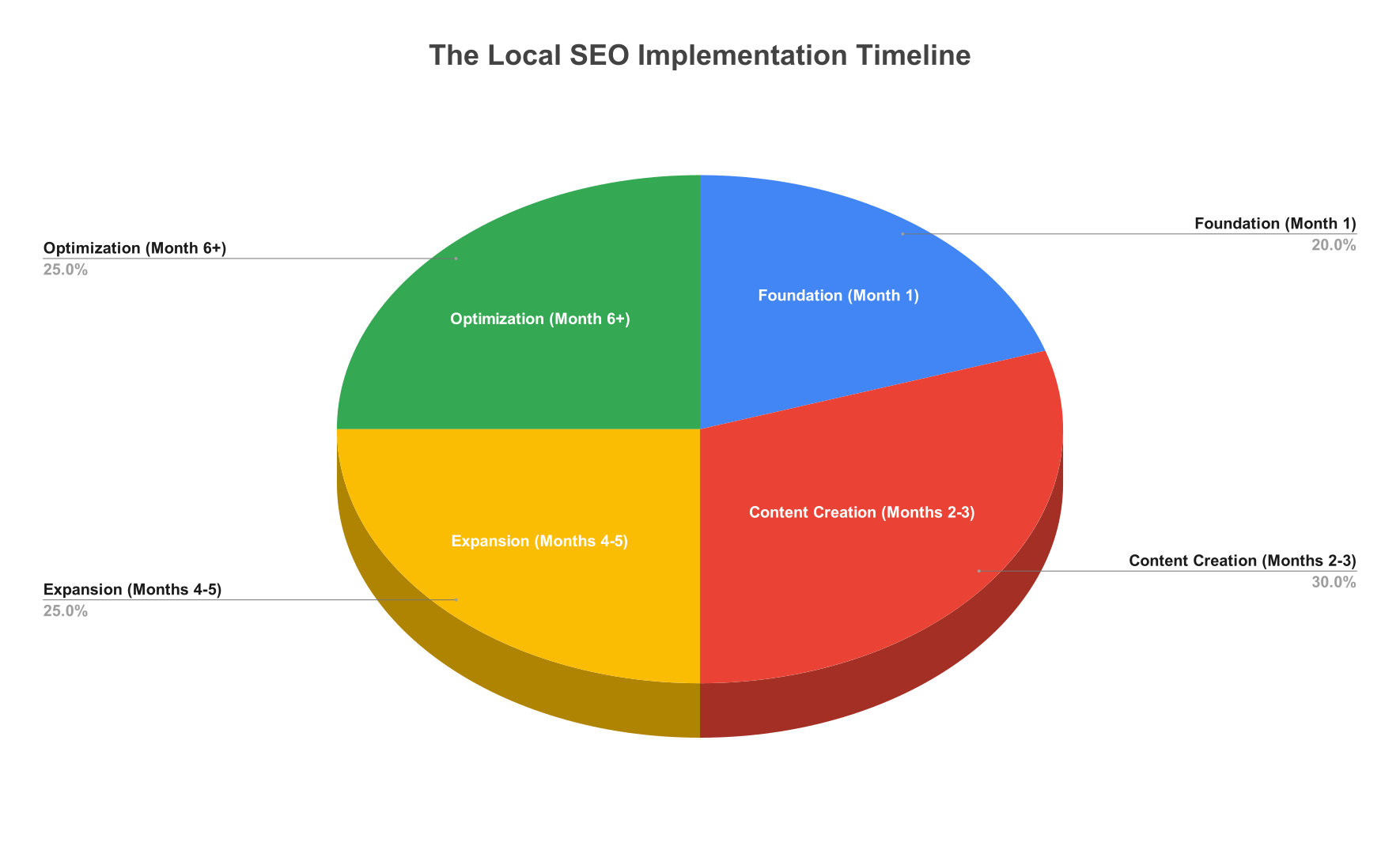
The Local SEO Implementation Timeline
Our local SEO implementation process begins with building a strong foundation through Google Business Profile optimization, review generation systems, and strategically developed service area pages. From there, we expand geographic coverage and continuously optimize performance through ongoing content updates, internal linking improvements, ranking analysis, and local authority growth.
Conclusion
Local SEO success requires two strategies working together. Optimize your Google Business Profile aggressively to dominate the Local Pack, and create unique, valuable service area pages to capture organic rankings in every city you serve.
GBP optimization delivers faster results. You can improve Local Pack visibility within weeks by posting regularly, generating reviews, and completing your profile fully. Service area pages take longer but provide sustainable organic traffic once they rank.
The businesses winning local search invest consistently in both pillars. They treat their GBP as a living asset requiring weekly attention, and they create genuinely useful, unique content for each service area rather than taking shortcuts with duplicate templates.
Ready to dominate local search in your market? Contact Altus Marketing to discuss a local SEO strategy that drives qualified leads from every city you serve.