From May to September 2026, our research team analyzed Google Ads cost per lead and conversion benchmarks from WordStream, alongside Semrush’s earlier study of AI visitor value, then checked GEO pricing against WebFX’s October 2026 cost guide. We do not use private client data in this guide.
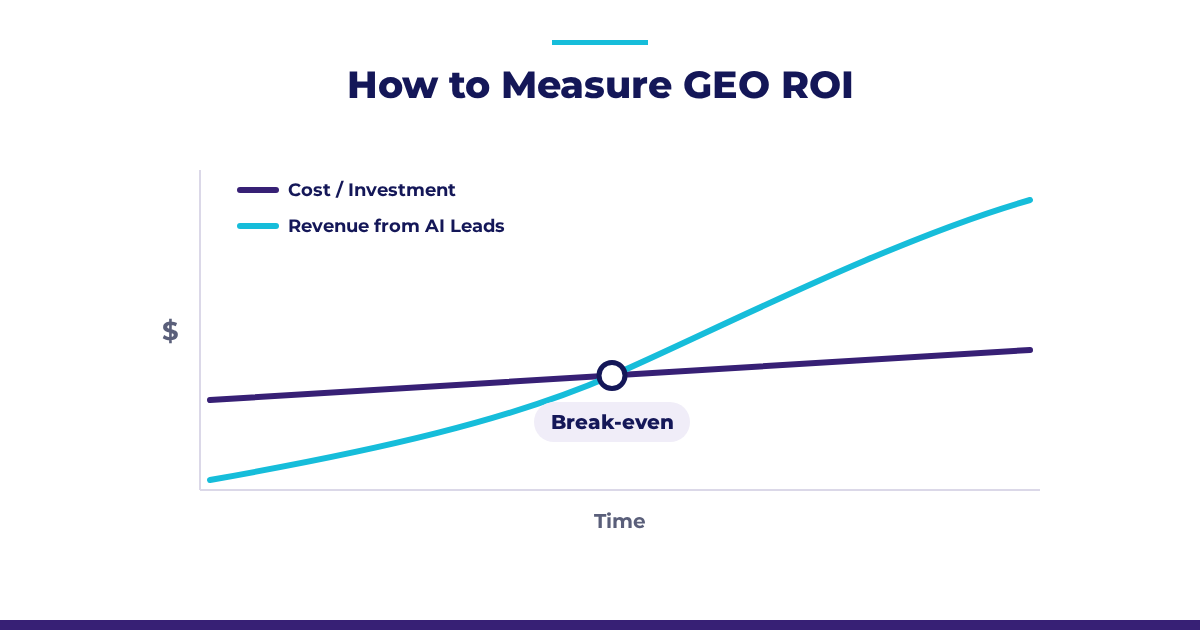
How can a small business measure whether GEO is paying off?
This guide breaks down GEO measurement by lead source (AI referrals compared with Google Ads leads) and break-even by service category (16 industries).
To measure GEO ROI for your small business, follow four steps: track AI referral traffic in Google Analytics 4, attribute the leads and calls that traffic produces, assign revenue to those leads, then calculate ROI with a simple formula. This guide walks through each step, then shows how to judge the result against a break-even benchmark for your industry.
- Track AI referrals in GA4 with a custom channel group for ChatGPT, Gemini, Perplexity, Claude and Copilot.
- Attribute calls and forms with call tracking, a form source field and a ‘how did you hear about us’ question that includes AI tools.
- Assign revenue with your real close rate and average customer value, not industry averages.
- The average AI search visitor is worth 4.4 times the average organic visitor (Semrush), so small volumes can still matter.
Step 1: Track AI Referral Traffic in GA4
AI-referred visits are sessions that originate from a citation or link inside ChatGPT, Gemini, Perplexity, Claude or Copilot. Google Analytics 4 records them as referrals, so the first job is to separate them from the rest of your traffic.
- In GA4, go to Admin, then Data display, then Channel groups, and create a new channel group.
- Add a channel named AI Referrals above Referral, with the condition Session source matches regex:
chatgpt|openai|gemini|perplexity|claude|copilot. - Open Reports, then Acquisition, then Traffic acquisition, and switch the dimension to your new channel group.
- Mark your key actions (form submits, click-to-call, bookings) as key events so they appear next to AI sessions.
- Note the limits: visits from Google AI Overviews and AI Mode arrive as Google organic traffic, and some AI apps strip referrer data, so GA4 will undercount AI influence.
Step 2: Attribute Leads and Calls to AI Search
Small businesses get many leads by phone, so web sessions alone miss part of the picture. Connect each lead to its source:
- Use call tracking with a dynamic number on your website so calls from AI-referred sessions are tagged to that source.
- Pass the session source into a hidden field on contact forms so each submission records where it came from.
- Add ‘ChatGPT or another AI tool’ as an option on your ‘How did you hear about us?’ question; this captures customers who heard your name in an AI answer and searched for you later.
- Each month, record whether ChatGPT, Gemini and Perplexity name your business for the 10-20 questions your customers ask most. One check is a snapshot; the trend is what matters.
Step 3: Assign Revenue to AI-Referred Leads
Turn leads into dollars with your own numbers. Revenue from AI search = AI-attributed leads x your close rate x your average customer value. Use gross profit instead of revenue if your margins vary widely between services. Average Customer Value is the variable that swings hardest by industry, which is why the break-even point varies so much from sector to sector below.
Step 4: Calculate GEO ROI
GEO ROI follows the same basic formula as any marketing ROI calculation, applied to a specific kind of traffic:
GEO Investment covers content production, technical work (structured data, crawlability, site speed), citation-tracking tools, and either staff hours or agency fees. Measure over at least 90 days, because AI visibility changes often and a single month is noisy. If the result is negative early on, compare it against the break-even benchmark below before deciding to stop.
How Much Does GEO Cost?
You need your GEO investment figure for the formula. The table below shows published ranges.
| Option | Typical Monthly Cost | What It Covers |
|---|---|---|
| DIY tools and AI visibility software | $10-$1,000+ | Prompt tracking, citation monitoring |
| AI visibility tracking tools | $50-$1,000+ | Measuring how AI platforms mention your brand |
| Agency GEO services | $1,500-$50,000+ | Content, technical work, third-party mentions, tracking |
Benchmark: GEO Break-Even by Industry
Once you are measuring, you need a target. The chart and table below show how many AI-referred leads per month a $1,500 GEO budget must produce to match each industry’s average Google Ads cost per lead, sorted from easiest to hardest break-even.
| Industry | Google Ads Cost per Lead | Break-Even Leads per Month | Visits Needed per Month |
|---|---|---|---|
| Personal Injury & Family Law | $131.63 | 11 | 205 |
| Furniture & Home Goods Retail | $106.70 | 14 | 470 |
| Real Estate Brokerages | $102.51 | 15 | 395 |
| IT Services & Accounting | $93.69 | 16 | 330 |
| Home Services, Roofing & Remodeling | $90.92 | 16 | 205 |
| Tutoring & Education | $77.48 | 19 | 147 |
| Financial, Insurance & Mortgage | $74.44 | 20 | 763 |
| Dental Practices | $72.97 | 21 | 193 |
| Fitness Studios & Gyms | $67.36 | 22 | 321 |
| Wedding, Event & Personal Services | $54.60 | 27 | 223 |
| Boutique Retail & Gifts | $49.40 | 30 | 757 |
| Medical Practices & Physical Therapy | $40.04 | 37 | 301 |
| Hair Salons & Beauty | $39.25 | 38 | 369 |
| Pet Services & Veterinary | $31.50 | 48 | 294 |
| Restaurants (Full-Service) | $30.57 | 49 | 610 |
| Auto Repair Shops | $29.96 | 50 | 323 |
Our analysis found that GEO pays back fastest in legal services, furniture and home goods, real estate and B2B services such as IT and accounting, where paid leads cost $90-$130 or more and about 11-16 AI-referred leads per month beat paid search. The hardest break-even is in auto repair, restaurants, pet services and beauty, where paid leads cost $30-$40 and roughly 38-50 AI-referred leads per month are needed. For those low-ticket, hyperlocal businesses, Google Business Profile and review visibility usually come before dedicated GEO spend.
Why Small-Business GEO Is Harder to Measure
- Harder attribution. Some AI influence never shows up as a referral, such as a customer who hears your name in an answer and searches for you later.
- Local intent. Many local questions are answered from Google Business Profiles, reviews and directories, so GEO results often appear as local SEO gains.
- Smaller samples. A few leads a month can swing ROI sharply, so judge trends over a quarter, not a single month.
These benchmarks are directional, not guarantees. GEO-specific tracking data is still young, and the right move for any small business is to start tracking its own AI citation and conversion numbers as soon as it begins investing.
Altus will audit your GA4, call tracking and AI visibility, then show you how to measure GEO ROI with your real customer value. Plans are custom quoted, and it starts with a free audit and strategy call.
Get a free audit and strategy callFrequently Asked Questions
How do I track ChatGPT traffic in Google Analytics 4?
Create a custom channel group with a channel whose session source matches a regex such as chatgpt|openai|gemini|perplexity|claude|copilot, then view it in the Traffic acquisition report.
Can I measure traffic from Google AI Overviews?
Not separately in GA4. Clicks from AI Overviews and AI Mode are reported as Google organic traffic.
How long should I measure before judging GEO ROI?
At least 90 days, because AI answers change often and small monthly lead counts are noisy.
How much does GEO cost?
WebFX reports $10-$1,000+ per month for DIY tools and $1,500-$50,000+ per month for agency services (October 2026).
How is GEO different from SEO?
SEO helps you rank in search results; GEO helps you get cited in AI answers. They share most of the same foundations. See GEO vs. SEO for Small Businesses.
Tell us what a customer is worth to your business. We will set up the tracking, calculate your break-even point and walk you through a custom GEO plan on a free strategy call.
Get a free audit and strategy callRelated Reading
- Which AI Platforms Send the Most Traffic in 2026?
- GEO vs. SEO for Small Businesses
- How Much Does SEO Cost for a Small Business in 2026?
Sources
- GEO Cost: How Much Does Generative Engine Optimization Cost?
Author: WebFX
Publication: WebFX
Date: October 15, 2026
URL: https://www.webfx.com/blog/ai/generative-engine-optimization-cost/ - AI Search and SEO Traffic Study
Author: Semrush
Publication: Semrush Blog
Date: 2025
URL: https://www.semrush.com/blog/ai-search-seo-traffic-study/ - Google Ads Benchmarks 2026
Author: WordStream by LocaliQ
Publication: WordStream
Date: 2026
URL: https://www.wordstream.com/blog/2026-google-ads-benchmarks