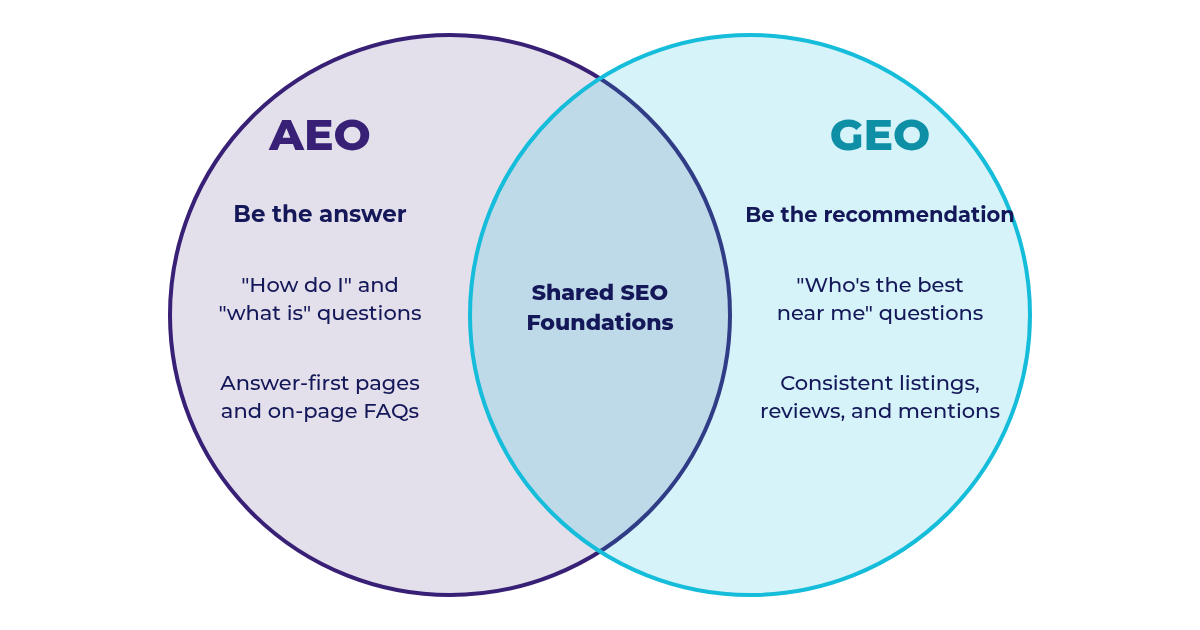
AEO (answer engine optimization) helps your content get used as the answer when someone asks a question. GEO (generative engine optimization) helps your business get named when someone asks an AI tool for a recommendation. They overlap heavily, and both rest on ordinary SEO. This guide explains the difference and walks through 8 steps to put both to work.
AEO vs. GEO at a Glance
| AEO | GEO | |
|---|---|---|
| Goal | Your content is quoted or used as the answer | Your business is named or recommended |
| Typical question | “How do I fix a leaking faucet?” | “Who’s the best plumber near me?” |
| Where it shows | Featured snippets, AI Overviews, voice answers | AI Overviews, AI Mode, ChatGPT, Perplexity, Maps |
| Main levers | Answer-first pages, clear headings, on-page FAQs | Consistent business info, reviews, reputable mentions |
| How to measure | Search Console impressions and clicks | Monthly AI answer checks, AI referral traffic |
The 8 Steps
1Decide which questions matter most to your business
List the questions customers ask before they buy. Sort them into informational questions (“how often should a furnace be serviced?”) and recommendation questions (“who services furnaces near me?”). Informational questions are AEO territory; recommendation questions are GEO territory. For many lead-driven local businesses, the second group is closest to a sale, so it is a sensible place to start.
2Cover the basics both depend on
Google says its AI Overviews and AI Mode have no additional requirements beyond normal Search eligibility: the page must be indexed and able to show a snippet. Make sure your site is crawlable, fast, and internally linked, and that robots.txt doesn’t block OAI-SearchBot (ChatGPT search) or PerplexityBot if you want to appear in those tools.
3Write answer-first content (AEO)
Use headings that match real questions and answer each one in the first sentence or two beneath it. Google says you can’t mark a page as a featured snippet; its systems decide which page answers a search best. Clear, direct answers give any answer engine something accurate to quote.
4Add on-page FAQs for readers, not for rich results (AEO)
FAQ sections on service pages still help visitors and give AI systems clear question and answer pairs. Just know that since August 2023 Google only shows FAQ rich results for well-known government and health sites, and it has deprecated How-to rich results entirely. Structured data that matches your visible content is fine, but Google says no special schema is needed for its AI features.
5Make your business easy to identify (GEO)
Keep your name, address, phone, services, and service area identical on your website, Google Business Profile, Bing Places, Apple Business Connect, and directories. State clearly on your site what you do, who you serve, and where.
6Earn reviews and real third-party mentions (GEO)
Google says more reviews and positive ratings can help local ranking. Beyond reviews, seek coverage on reputable, relevant sites: local news, industry associations, expert interviews, and genuine awards. Recommendation answers lean on what others say about you, not only what you say about yourself.
7Back up your claims
Add author bios, explain your process, and link to the sources behind any figures you publish. Google’s helpful content guidance asks whether content shows clear sourcing and first-hand expertise. Unsourced statistics weaken trust with readers and AI systems alike.
8Measure each side separately
For AEO, track which informational pages earn impressions and clicks in Search Console (AI Overviews and AI Mode traffic is included in the Web search type). For GEO, ask ChatGPT, Perplexity, and Google your recommendation questions each month and note whether your business is named, and watch referral traffic from AI platforms in your analytics.
FAQ
Which should a small business do first?
If your revenue comes from people ready to hire, start with GEO basics: consistent business info and reviews. Add AEO content next, since it builds the authority that supports recommendations.
Is AEO just SEO with a new name?
Mostly it is SEO focused on direct answers. The fundamentals are the same; the emphasis is on question-based structure and concise answers.
Do I still need FAQ schema?
It won’t produce FAQ rich results for most sites since 2023, and Google says no special schema is needed for its AI features. On-page FAQ content is still worth having for readers.
Where did the term GEO come from?
It was introduced in a 2023 research paper by Aggarwal and colleagues titled “GEO: Generative Engine Optimization.”
Sources
- Google Search Central: AI features and your website
- Google Search Central: Featured snippets and your website
- Google Search Central: Changes to HowTo and FAQ rich results (August 2023)
- Google Business Profile Help: Tips to improve your local ranking on Google
- Google Search Central: Creating helpful, reliable, people-first content
- OpenAI: Overview of OpenAI crawlers
- Perplexity: Perplexity crawlers
- Aggarwal et al., GEO: Generative Engine Optimization (arXiv, 2023)