Mental health therapy practices operate with an acquisition dynamic unlike most of outpatient healthcare: client lifetime value is unusually high relative to cost, the professional referral network remains one of the most efficient acquisition channels in any service sector, and the choice between private pay and insurance panels reshapes the economics of every marketing decision a practice makes. These dynamics mean the CAC numbers that matter most are rarely the ones a marketing vendor quotes.
This piece breaks down therapy practice CAC by acquisition channel, practice type and size, clinical specialty, and payment model using 2026 data from independent practitioners and group practices across private pay and insurance-based settings.
CAC by Acquisition Channel
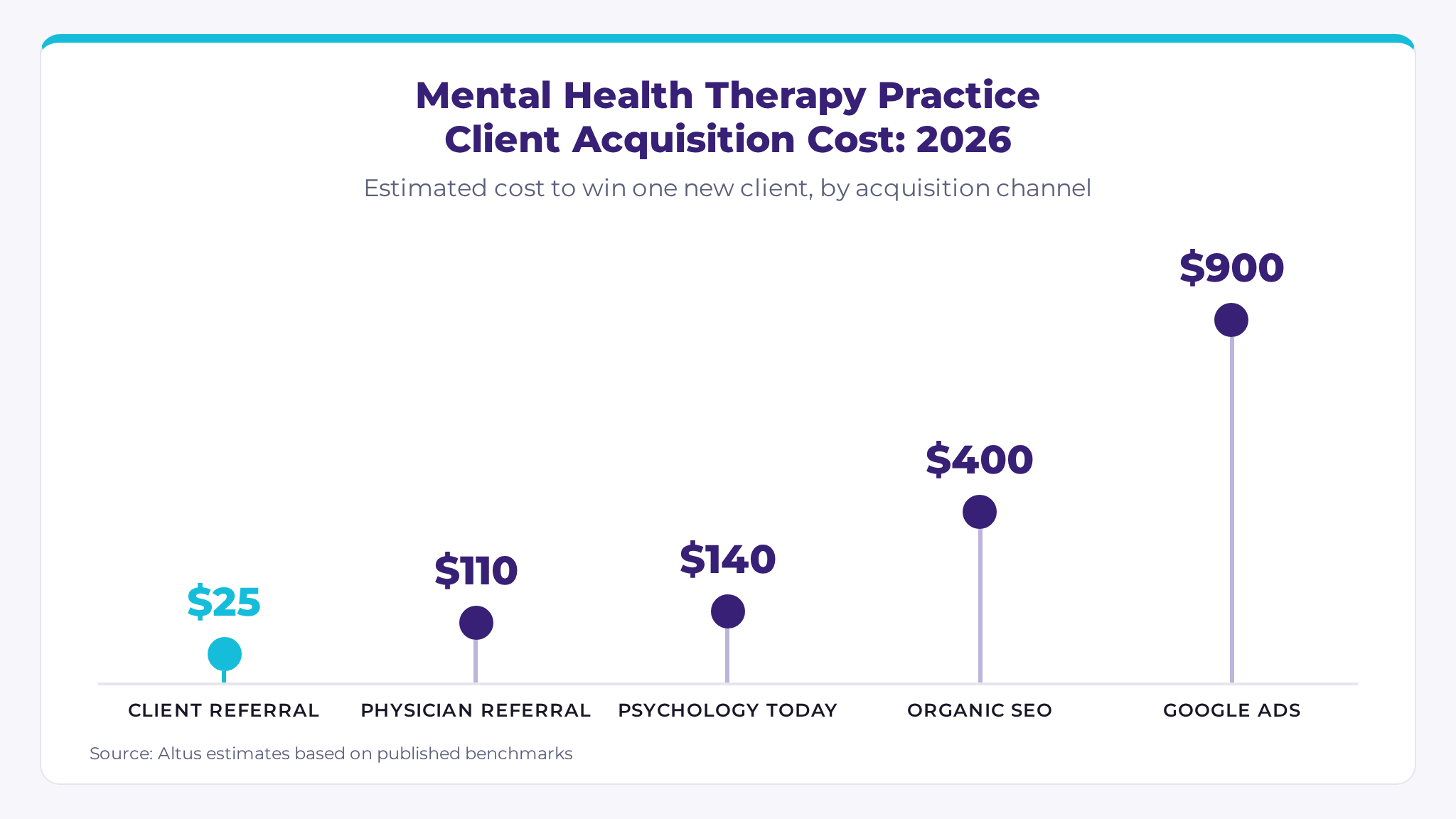
The table below breaks down average acquisition cost and lifetime value return across the channels therapy practices most commonly use to bring in new clients.
- Client referrals and word of mouth deliver the strongest return by a significant margin and represent 30-50% of new clients for most established practices with near-zero direct acquisition cost
- EAP panels show a low absolute CAC but EAP client LTV is roughly one-third of a private pay client; panels are most effective as a volume supplement or credentialing tool rather than a primary revenue channel
- Organic SEO and GEO occupies the practical middle ground: higher upfront cost than directory and referral channels, but it scales without proportional cost increases and attracts high-intent clients who have already researched the therapist before reaching out
- Paid search and social media carry the weakest LTV-to-CAC ratios in the therapeutic vertical and are most useful for specialty practices targeting specific diagnoses or demographics that are harder to reach through directory and referral channels
CAC by Practice Type and Size
The table below breaks down average marketing spend, new client volume, and acquisition cost by practice structure and size.
| Practice Type | Avg Monthly Marketing Spend | Avg Monthly New Clients | Average CAC |
|---|---|---|---|
| Solo practitioner | $400-$900 | 3-6 | $130 |
| Small group (2-5 clinicians) | $1,200-$2,500 | 8-16 | $160 |
| Mid-size group (6-15 clinicians) | $3,000-$6,500 | 20-40 | $155 |
| Large group / DSO model (15+ clinicians) | $7,500-$18,000 | 50-100 | $160 |
| Telehealth-only | $1,800-$4,500 | 15-35 | $125 |
| Hybrid (in-person and telehealth) | $2,000-$5,000 | 15-35 | $145 |
- Solo practitioners run the lowest average CAC largely because a meaningful share of new clients arrives through personal professional relationships that group practices cannot replicate at scale
- Telehealth-only practices carry the lowest average CAC among model types, benefiting from wider geographic targeting and lower cost-per-lead on digital channels; session rate compression in crowded telehealth markets can limit LTV, partially offsetting the acquisition advantage
- CAC flattens quickly beyond the small group tier; mid-size and large group practices post similar acquisition costs because incremental marketing spend at that scale absorbs additional clinician capacity rather than producing per-client efficiency gains
- Hybrid practices accept a modest CAC premium over telehealth-only but typically produce longer client engagements, as in-person sessions are associated with higher long-term retention rates
CAC by Clinical Specialty
The table below breaks down acquisition cost, primary channel, and lifetime value by clinical specialty and niche.
| Clinical Specialty | Average CAC | Primary Acquisition Channel | Average Client LTV |
|---|---|---|---|
| General adult (anxiety, depression) | $175 | Psychology Today, organic SEO | $6,500 |
| Trauma and EMDR | $155 | Referral network, organic SEO | $9,200 |
| Couples and marriage counseling | $230 | Google Ads, organic SEO | $5,400 |
| Adolescent and child | $145 | Pediatrician and school counselor referrals | $7,800 |
| OCD and anxiety (specialist focus) | $190 | Specialty directories, OCD treatment networks | $10,500 |
| Addiction and dual diagnosis | $175 | EAP, treatment center referrals | $5,200 |
| Eating disorders | $160 | Dietitian and medical referral network | $11,000 |
| Perinatal and maternal mental health | $140 | OB/GYN and midwife referrals | $7,200 |
| LGBTQ+ affirming | $155 | Community organization referrals, affirming directories | $8,100 |
- Specialty practices with concentrated referral sources, including perinatal, adolescent, and eating disorder practitioners, run below-average CAC despite serving niche populations because a small number of high-volume referrers can sustain intake at low acquisition cost
- OCD and eating disorder specialties carry the highest average LTV on this list; clinical complexity and structured long-term treatment protocols drive engagement well beyond the timelines typical in general adult therapy
- Couples and marriage counseling posts the highest average CAC in part because it draws more heavily on paid search, where high commercial intent is offset by a broader audience that is harder to filter by readiness before the first session
- Trauma and EMDR work produces strong LTV-to-CAC ratios because trauma-focused therapy is both long in duration and low in dropout once a therapeutic relationship is established
CAC by Payment Model
The table below breaks down acquisition cost, session rates, lifetime value, and return ratio by payment model structure.
| Payment Model | Average CAC | Average Session Rate | Average Client LTV | LTV-to-CAC Ratio |
|---|---|---|---|---|
| Private pay only | $280 | $175-$250 | $8,500 | 30:1 |
| Insurance-only (fully paneled) | $95 | $85-$130 | $4,200 | 44:1 |
| Hybrid (private pay with selective insurance) | $185 | $145-$190 | $6,800 | 37:1 |
| EAP-primary | $60 | $60-$95 | $2,500 | 42:1 |
| Sliding scale / community model | $110 | $50-$120 | $3,800 | 35:1 |
- Insurance-only practices carry the lowest CAC and a favorable-looking LTV-to-CAC ratio, but the ratio overstates the return when billing overhead, credentialing costs, and panel administrative burden are factored into the true cost of maintaining those panels
- Private pay practices accept a CAC roughly three times higher than insurance-only, offset by an LTV roughly twice as high; the premium reflects heavier dependence on digital channels and reputation, with no insurance directory to direct clients inbound
- Hybrid models produce the strongest practical outcome for most growth-stage practices: moderate acquisition cost, meaningful session rates, and flexibility to convert insurance clients to private pay as the schedule fills
- EAP-primary practices trade long-term revenue potential for volume and predictability; EAP clients rarely convert to private pay after their covered sessions conclude, making this model most viable as a supplement to an existing panel rather than a standalone acquisition strategy
If you’d like a PDF copy of this report or help lowering your therapy practice’s client acquisition cost, contact Altus.
Sources
- National Institute of Mental Health - Mental Illness Statistics
- SAMHSA - National Survey on Drug Use and Health
- American Psychological Association - Workforce Data
- Psychology Today - Find a Therapist Directory
- SimplePractice - Private Practice Resources
- Headway - Therapist Platform
- National Council for Mental Wellbeing - Behavioral Health Workforce