From January 2024 through November 2026, our research team at Altus Marketing compiled client acquisition cost data across independent tax preparers, enrolled agents, small tax firms, and national franchise locations. Our methodology applied a weighted model accounting for business model, geographic market, lead source, and return complexity to produce the figures below.
The tables that follow break down tax preparer client acquisition cost by lead source, return type, new versus retained client economics, and tax preparer business model.
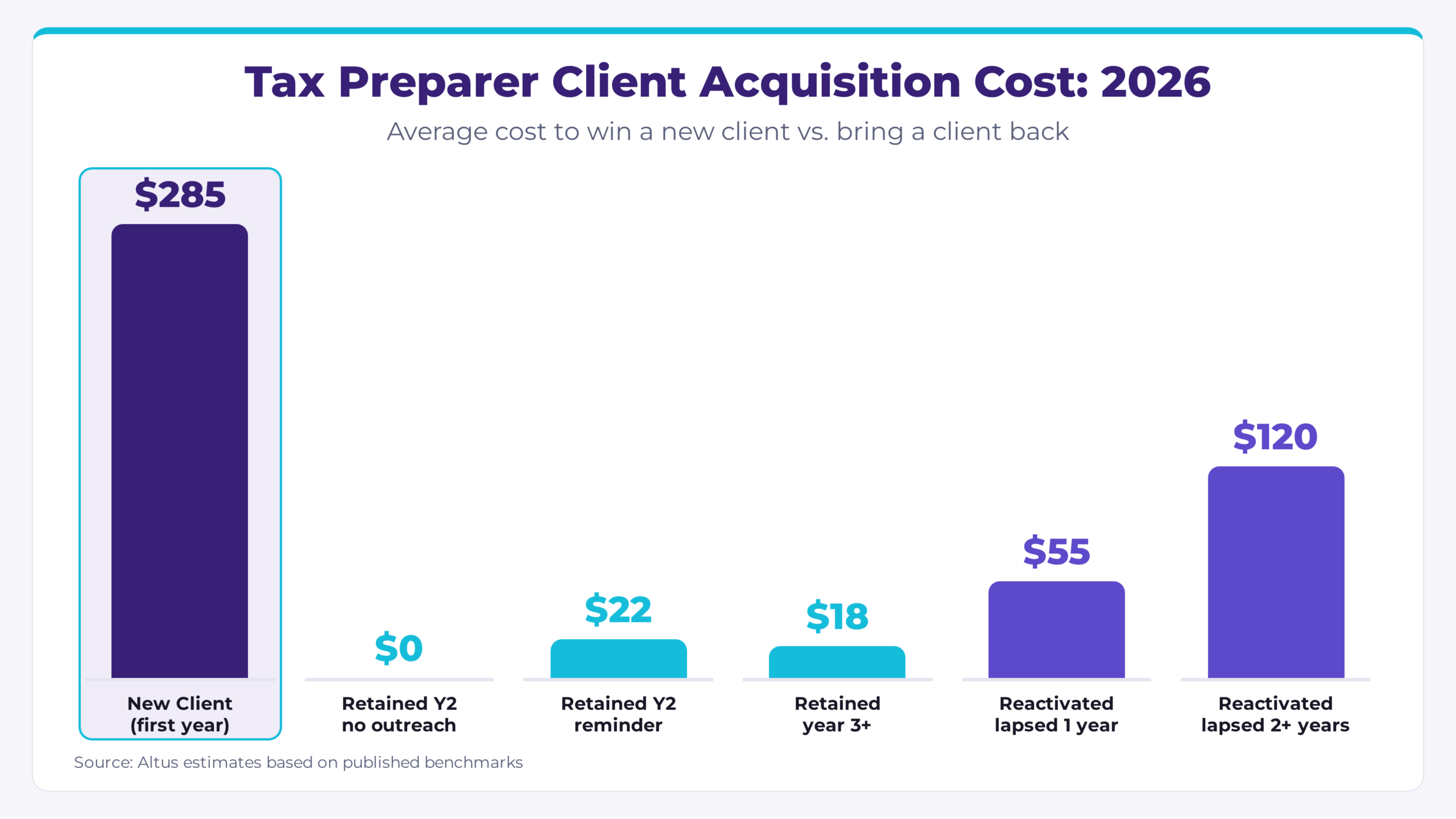
- Retained clients cost $18-$55 to bring back for another filing season, compared to roughly $285 to acquire a comparable new client, making client retention the highest-ROI activity in tax preparation marketing
- Referral and word of mouth produces the lowest new-client CAC of any channel, averaging $110
- Self-employed and business returns carry a higher CAC than simple W-2 returns but deliver substantially better fee-to-CAC ratios, making upmarket positioning a strong acquisition strategy
- Organic SEO is particularly effective for tax preparers because clients actively search for tax help during a defined seasonal window, concentrating high-intent demand into a predictable period
Tax Preparer Client Acquisition Cost by Lead Source: 2026
The table below breaks down average new-client acquisition cost by lead source for tax preparers in 2026.
| Lead Source | Avg. CAC |
|---|---|
| Referral / Word of Mouth | $110 |
| Community / Church / Association Network | $95 |
| Organic SEO | $240 |
| Tax Season Signage / Retail Visibility | $175 |
| Promotional / Discount Offer (first-year) | $190 |
| Yelp / Local Directory | $275 |
| Google Local Services Ads | $290 |
| Direct Mail / Door Hangers | $280 |
| Social Media Ads (Meta) | $350 |
| Google Search Ads (PPC) | $420 |
- Community and church networks produce the lowest new-client CAC of any channel and generate clients with strong referral potential and high return rates
- Referral produces consistently low CAC and high close rates but requires deliberate cultivation through a structured client referral program
- Organic SEO delivers a scalable inbound CAC well below paid channels and captures high-intent searches during the January through April filing window
- Paid search CAC is highest but can be justified for preparers targeting complex returns, self-employed clients, or small business filers where average fees are significantly higher
Tax Preparer Client Acquisition Cost by Return Type: 2026
The table below breaks down average client acquisition cost, average tax preparation fee, and average CAC as a percentage of fee by return type in 2026.
| Return Type | Avg. CAC | Avg. Prep Fee | CAC as % of Fee |
|---|---|---|---|
| W-2 Only (1-2 forms) | $95 | $180-$280 | 40% |
| W-2 + Itemized Deductions | $120 | $220-$380 | 37% |
| Rental Property / Schedule E | $175 | $350-$600 | 36% |
| Self-Employed / Schedule C | $190 | $380-$650 | 35% |
| Amended Return / Back Taxes | $155 | $300-$800 | 30% |
| Multi-State / Complex Individual | $260 | $500-$1,200 | 29% |
| S-Corp or Partnership Return | $340 | $900-$2,500 | 19% |
| Small Business + Personal Bundle | $420 | $1,200-$3,500 | 17% |
- Simple W-2 returns have the lowest absolute CAC but also the worst CAC-to-fee ratio, consuming 37-40% of the first-year fee
- Self-employed and rental property clients represent a strong acquisition target, with a CAC-to-fee ratio roughly 10 points better than simple individual returns
- S-Corp, partnership, and small business returns offer the best acquisition economics by far, with CAC consuming only 17-19% of the first-year preparation fee
- Positioning toward business and complex filers is one of the highest-leverage moves a tax preparer can make to improve long-term acquisition economics
New Client vs. Retained Client Acquisition Cost for Tax Preparers: 2026
Tax preparation is one of the few professional services where a client acquired once can produce revenue for ten or more years with minimal reacquisition cost. The table below breaks down average acquisition and reacquisition cost by client status for tax preparers in 2026.
| Client Status | Avg. CAC | Avg. First-Year Fee | Net Margin After CAC | Notes |
|---|---|---|---|---|
| New Client (first year) | $285 | $350 | 19% | Full acquisition cost applies |
| Retained Client (year 2, no outreach) | $0 | $350 | 100% | Client returns without prompting |
| Retained Client (year 2, reminder outreach) | $22 | $360 | 94% | Email or text reminder campaign |
| Retained Client (year 3+) | $18 | $375+ | 95% | Small annual fee increase typical |
| Reactivated (lapsed 1 year) | $55 | $350 | 84% | Targeted win-back outreach |
| Reactivated (lapsed 2+ years) | $120 | $350 | 66% | Requires more aggressive outreach |
- A retained client who returns without any outreach produces 100% gross margin on the preparation fee, making retention the single highest-ROI activity in a tax preparer’s marketing budget
- A simple email or text reminder campaign in January costs roughly $22 per returned client and captures the majority of clients who would otherwise consider switching
- Reactivating a client lapsed one year is roughly 80% cheaper than acquiring a new client at equivalent fee value
- A tax preparer with a 75% year-over-year retention rate has a blended CAC that is roughly one-third the cost of a preparer who starts each season from zero
Tax Preparer Client Acquisition Cost by Business Model: 2026
The table below breaks down average client acquisition cost by tax preparer business model and structure in 2026.
| Business Model | Avg. Monthly Marketing Spend | Avg. Monthly New Leads | Avg. Close Rate | Avg. CAC |
|---|---|---|---|---|
| Solo Independent Preparer | $200-$600 | 3-8 | 52% | $195-$420 |
| Independent Enrolled Agent (EA) | $400-$1,200 | 6-15 | 57% | $175-$380 |
| Small Firm (2-5 preparers) | $800-$2,500 | 15-35 | 50% | $155-$340 |
| National Franchise Location | $1,500-$4,000 | 35-80 | 48% | $110-$280 |
| Online-Only Tax Service | $5,000-$20,000+ | 150-500 | 12% | $200-$380 |
- Enrolled agents achieve the highest close rate of any model because the EA credential signals IRS authority and builds client trust before the first conversation ends
- National franchise locations achieve the lowest absolute CAC through brand recognition and high lead volume, but face the highest direct competition at the point of inquiry
- Online-only tax services run significantly higher lead volume but very low close rates due to broad top-of-funnel targeting and high price sensitivity among digital-first filers
- Solo preparers carry the highest relative CAC burden and benefit the most from referral program development, niche positioning, and organic SEO investment
What Drives Tax Preparer Client Acquisition Cost Up or Down?
Several variables consistently separate tax preparers with a blended CAC under $100 from those spending $400 or more per new client.
Client retention rate is by far the most powerful lever. A tax preparer retaining 80% of clients year over year effectively acquires 80% of their revenue base at near-zero cost each season, concentrating their marketing spend entirely on the 20% that must be replaced. Conversely, a preparer with a 50% retention rate must acquire twice as many new clients each year to hold revenue flat, multiplying their effective CAC across the entire book of business. A simple January reminder campaign, a brief year-end follow-up call, and a consistent client experience are the three highest-ROI retention investments available.
Return complexity mix directly determines how efficiently each marketing dollar converts. A solo preparer optimizing for W-2-only clients builds a high-volume, low-margin practice where CAC consumes a large share of each first-year fee. A preparer who actively recruits self-employed clients, real estate investors, and small business owners builds a practice where the same CAC converts against fees that are three to ten times higher. The same Google Local Services ad or SEO investment produces dramatically different economics depending on who it attracts.
Seasonal SEO and content visibility matters more for tax preparers than for almost any other professional service category. Clients who are not already committed to a preparer actively search for tax help in a defined seasonal window, with search volume peaking in January and February. Preparers who have established content authority before this window opens capture high-intent organic leads at a fraction of the cost of late-season paid campaigns. Building and publishing educational content in October through December, before the rush, is one of the most cost-efficient acquisition investments in the category.
First-year client experience determines referral volume and return rate more than any other single factor. A client who feels confident, informed, and well-served after their first appointment returns the following year without prompting and refers friends and family before the next season begins. A client who felt uncertain, waited too long for a response, or received unexpected fees switches to a competitor or DIY software. The first appointment is simultaneously the final step in acquisition and the first step in retention, making client experience investment directly measurable in future CAC reduction.
To download a copy of this report or get in contact with our team, please reach out here: Contact Altus Marketing.
Sources
- Altus Marketing Research Team. "Client Acquisition Cost Analysis: Tax Preparers." Altus Marketing. November 2026. altusmarketing.co
- National Association of Tax Professionals. "Tax Preparers Industry Survey." NATP. 2026. natptax.com
- National Society of Accountants. "Income and Fees of Accountants and Tax Preparers Survey." NSA. 2026. nsacct.org
- Hinge Marketing. "High Growth Study: Accounting and Financial Services Firms." Hinge Marketing. 2026. hingemarketing.com
- WordStream. "Google Ads Benchmarks by Industry." WordStream. 2026. wordstream.com
- BrightLocal. "Local Consumer Review Survey." BrightLocal. 2026. brightlocal.com