Addiction treatment centers operate inside one of the most complex and expensive patient acquisition ecosystems in healthcare. Lead aggregators, pay-per-call networks, and LegitScript certification requirements shape the digital channel in ways that have no parallel in other healthcare verticals. Admission revenue varies by an order of magnitude across levels of care, payer sources are fragmented across commercial insurance, Medicaid, self-pay, and court-ordered referrals, and crisis-driven decision-making compresses timelines in ways that make the acquisition funnel behave differently than elective healthcare.
This piece breaks down addiction treatment CAC by acquisition channel, level of care, payer source, and program type using 2026 data from detox, residential, PHP/IOP, outpatient, and MAT programs.
CAC by Acquisition Channel
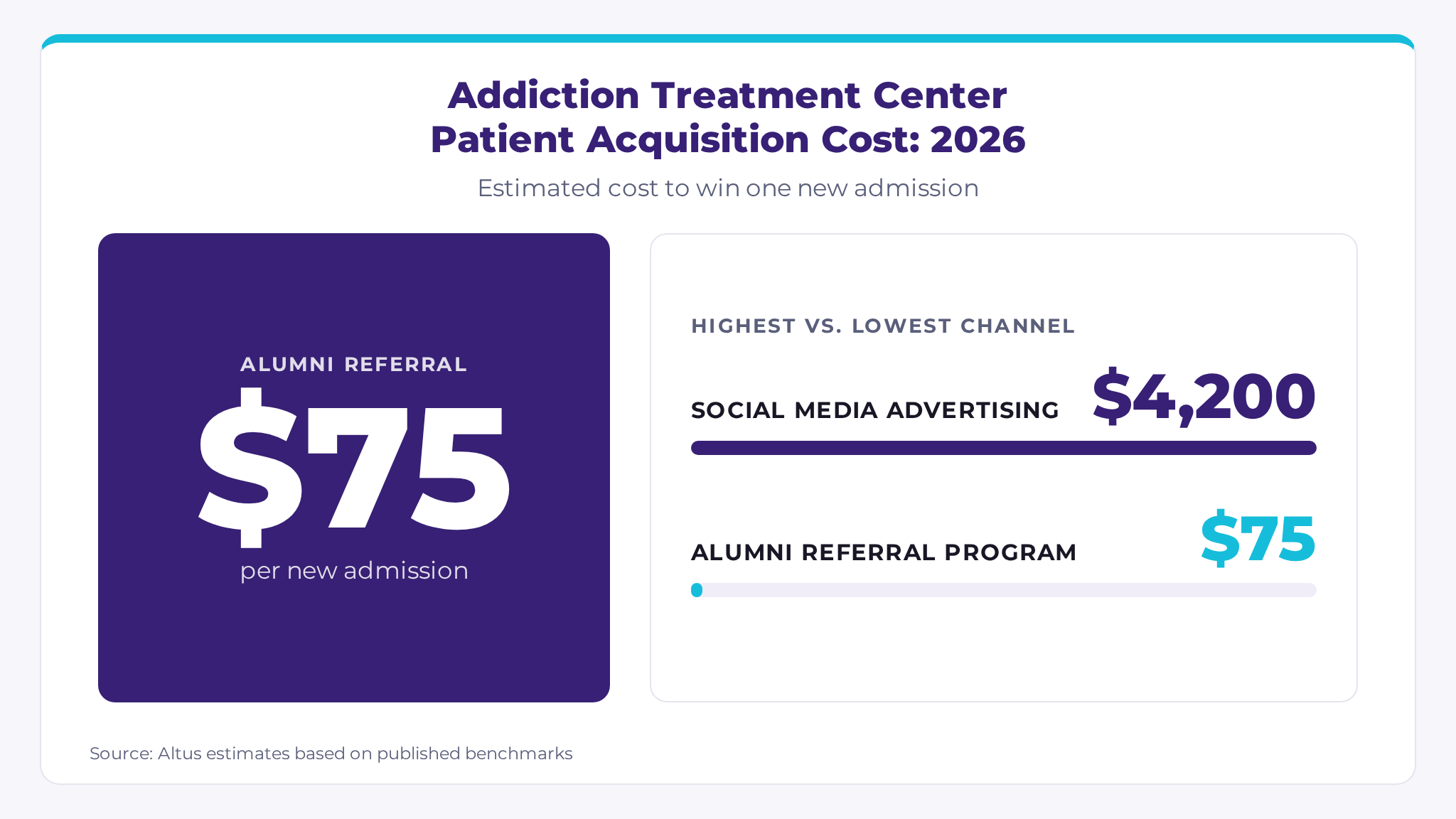
The table below breaks down average acquisition cost across the channels addiction treatment programs most commonly use to generate admissions, ordered from lowest to highest CAC.
- Alumni referral programs carry the lowest acquisition cost in the vertical and consistently produce the highest-intent admissions; programs with structured alumni networks generate 15-30% of monthly admissions through this channel
- Relationship-based channels (hospital discharge, physician, drug court) carry modest CAC but require sustained cultivation investment before producing consistent referral volume; they are the most defensible acquisition channels once established
- Lead aggregators and pay-per-call networks account for a disproportionate share of marketing spend at programs that have not built referral infrastructure; the high per-admission cost reflects low lead quality and wide funnel attrition from inquiry to insurance verification to admission
- Organic SEO and GEO occupies the strongest digital position in this vertical: LegitScript requirements limit who can run paid search, which concentrates high-intent organic traffic and reduces competition for programs that have built topical authority around treatment-related queries
CAC by Level of Care
The table below breaks down acquisition cost, average revenue per admission, and CAC as a percentage of revenue across the primary levels of care in addiction treatment.
| Level of Care | Average CAC | Avg Revenue per Admission | CAC as % of Revenue |
|---|---|---|---|
| MAT Clinic (ongoing, 24-month avg) | $400 | $9,600 | 4% |
| Standard Outpatient | $600 | $3,200 | 19% |
| Intensive Outpatient (IOP) | $1,100 | $6,500 | 17% |
| Partial Hospitalization (PHP) | $2,200 | $12,500 | 18% |
| Medical Detox (3-7 days) | $1,200 | $7,500 | 16% |
| Residential / Inpatient (28 days) | $4,800 | $28,000 | 17% |
| Residential / Inpatient (60-90 days) | $5,500 | $48,000 | 11% |
- MAT clinics carry the most favorable CAC-to-revenue ratio in the vertical; ongoing monthly revenue from long-term patients substantially outpaces acquisition cost and compounds over multi-year treatment relationships
- CAC as a percentage of revenue holds relatively steady across most levels of care at 15-19%, with the exception of MAT and long-stay residential, suggesting that marketing investment in this vertical tends to track revenue potential reasonably closely across program types
- Standard outpatient carries the least favorable ratio despite relatively low absolute CAC; the combination of modest per-admission revenue and digital channel competition in outpatient addiction markets compresses the return
- Long-stay residential (60-90 days) shows the strongest absolute CAC-to-revenue position because extended programs command significantly higher total revenue from the same admission, while acquisition cost scales modestly compared to the revenue differential
CAC by Primary Payer Source
The table below breaks down acquisition cost and average revenue per admission by the payer source driving the admission.
| Payer Source | Average CAC | Avg Revenue per Admission |
|---|---|---|
| Scholarship and Grant-Funded | $275 | $4,500 |
| Court-Ordered and Criminal Justice | $500 | $8,500 |
| EAP and Employer-Covered | $450 | $7,200 |
| Medicaid | $1,100 | $6,500 |
| Commercial Insurance (partial coverage) | $2,800 | $18,500 |
| Self-Pay (private pay) | $4,500 | $22,000 |
| Commercial Insurance (fully covered) | $3,200 | $28,000 |
- Court-ordered and criminal justice referrals carry some of the lowest CAC in the vertical because acquisition happens almost entirely through relationship-based channels (drug court liaisons, probation officers, defense attorneys) rather than digital marketing spend
- Commercial insurance admissions drive the highest absolute revenue and account for the majority of digital marketing investment in the vertical; LegitScript-certified Google Ads and lead aggregators target commercially insured patients almost exclusively
- Self-pay admissions are associated with premium and luxury programs; the CAC premium reflects heavier dependence on organic search, reputation management, and professional referral networks rather than the aggregator and paid search channels that dominate commercial insurance acquisition
- Medicaid admissions carry substantially lower revenue than commercial insurance, which fundamentally limits the acquisition budget available; Medicaid-primary programs rely heavily on community partnerships, hospital discharge networks, and drug court referrals to maintain manageable CAC
CAC by Program Type and Specialty
The table below breaks down acquisition cost, primary acquisition channel, and average revenue per admission by program specialty and target population.
| Program Type | Average CAC | Primary Acquisition Channel | Avg Revenue per Admission |
|---|---|---|---|
| Faith-Based Recovery | $1,800 | Church and community organization referrals | $12,000 |
| Veterans | $900 | VA partnerships, VSO referrals | $14,000 |
| MAT and Medication-Assisted Focus | $600 | PCP and urgent care referrals, organic SEO | $9,600 |
| Adolescent and Young Adult | $2,800 | School counselor and pediatric referrals | $24,000 |
| Gender-Specific (women’s or men’s) | $3,100 | Domestic violence organizations, SEO | $22,500 |
| General Adult (mixed population) | $3,200 | Lead aggregators, organic SEO, Google Ads | $22,000 |
| Dual Diagnosis (co-occurring) | $3,500 | Psychiatric and behavioral health referrals, SEO | $28,500 |
| Luxury and Executive | $5,800 | Organic SEO, referral network, PR and earned media | $65,000 |
- Faith-based and veterans programs carry below-average CAC because their primary acquisition channels are relationship-based referral networks (congregations, VSOs, VA facilities) that operate outside the competitive digital landscape that drives costs at general adult programs
- Luxury and executive programs post the highest absolute CAC in the vertical; that investment is offset by admission revenue that is 2-3 times higher than general adult programs, and the acquisition channels skew heavily toward organic search authority and professional reputation rather than aggregator spend
- Dual diagnosis programs carry a meaningful CAC premium over general adult programs, reflecting the more complex referral pathway that includes psychiatric providers and behavioral health systems alongside standard addiction referral sources; LTV is also meaningfully higher due to longer and more intensive treatment protocols
- Adolescent programs rely almost exclusively on referral-based acquisition through school counselors, pediatricians, and pediatric behavioral health providers; digital channels are less effective in this population because the admission decision-maker is typically the parent rather than the patient
If you’d like a PDF copy of this report or help lowering your treatment center’s patient acquisition cost, contact Altus.
Sources
- SAMHSA - National Survey on Drug Use and Health
- National Institute on Drug Abuse - Treatment Research Overview
- American Society of Addiction Medicine - ASAM Criteria and Level of Care
- LegitScript - Addiction Treatment Certification
- SAMHSA - Medication-Assisted Treatment Resources
- SAMHSA - Treatment Locator and Facility Directory
- National Alliance for Medication Assisted Recovery