Estate planning has one of the most distinctive client acquisition ecosystems in law. Demand is event-driven, referral networks extend into adjacent professions like financial advising and accounting, and client lifetime value often bears little relationship to the initial engagement fee.
This piece breaks down estate planning CAC across service type, acquisition channel, client life stage, and practice model, with an emphasis on the referral partner relationships that set estate planning marketing apart from other legal verticals.
Average Client Acquisition Cost by Service Type
This table breaks down average CAC across common estate planning service types alongside average engagement revenue and three-year client value, which is the differentiating metric in this analysis and reflects the recurring and referral-generating nature of estate planning relationships.
| Service Type | Avg. CAC | Avg. Engagement Revenue | Avg. 3-Year Client Value | Primary Acquisition Path |
|---|---|---|---|---|
| Simple Will Package | $280 | $850 | $1,400 | Digital, Referral |
| Estate Plan Review / Update | $200 | $750 | $2,900 | Existing Client, Referral |
| Revocable Living Trust | $420 | $2,200 | $3,800 | Referral, Digital |
| Comprehensive Estate Plan | $550 | $3,500 | $6,200 | Referral, Digital |
| Estate Administration / Probate | $600 | $5,500 | $4,200 | Referral, Attorney Network |
| Special Needs Trust | $950 | $4,500 | $8,000 | Healthcare / Advocacy Referral |
| Irrevocable Trust | $820 | $6,500 | $9,500 | Financial Advisor Referral |
| Business Succession Plan | $1,100 | $9,000 | $18,000 | CPA, Business Advisor Referral |
| High-Net-Worth Estate Plan | $1,400 | $15,000 | $38,000 | Wealth Advisor Referral |
- Simple will packages carry the lowest CAC in this table but also the lowest three-year client value; firms that treat initial simple-will engagements as a client acquisition investment rather than a standalone product typically capture two to four times that revenue from the same relationship over three years.
- Business succession and high-net-worth estate plans carry the highest nominal CAC but the strongest three-year value multiples, making them the most efficient acquisition category when measured by return on marketing investment rather than per-engagement margin.
- Estate administration and probate clients frequently arrive with immediate urgency after a death, but converting that engagement into a comprehensive plan for the client’s own affairs is where the long-term relationship value compounds most reliably.
- Special needs trusts and irrevocable trusts generate strong three-year value because they tend to draw families with ongoing planning needs, extended family referrals, and recurring review and administration work over time.
Average Client Acquisition Cost by Acquisition Channel
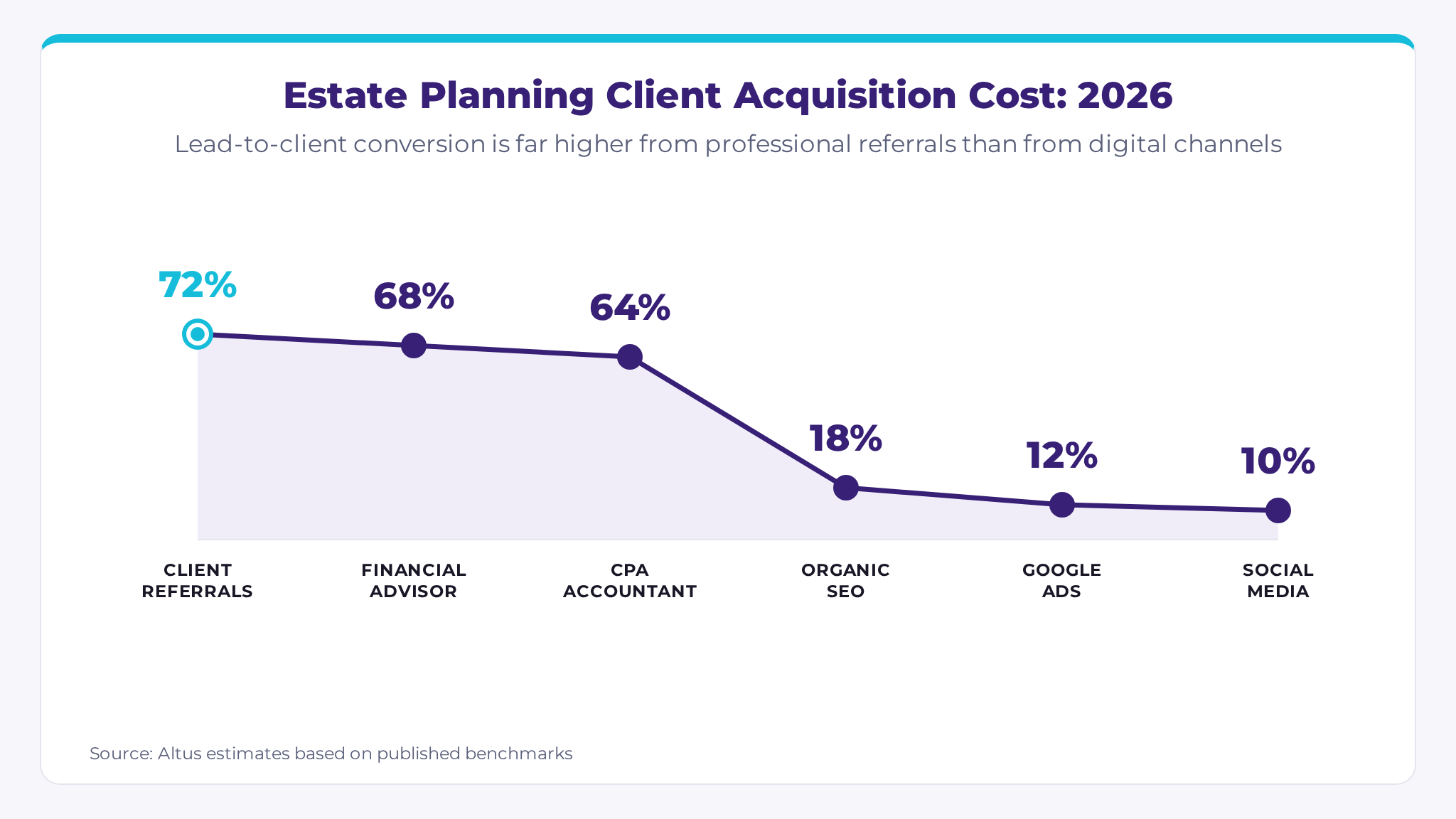
This table covers the full acquisition channel landscape for estate planning, including the cross-profession referral sources that play a larger role in this practice area than in almost any other legal vertical. The lead-to-client conversion rate column reflects how efficiently each channel produces signed engagements, not just inquiries.
| Acquisition Channel | Avg. CAC | Channel Type | Lead-to-Client Conversion Rate |
|---|---|---|---|
| Client Referrals | $150 | Peer | 72% |
| Financial Advisor Referrals | $220 | Professional | 68% |
| CPA / Accountant Referrals | $240 | Professional | 64% |
| Cross-Practice Attorney Referrals | $280 | Professional | 61% |
| Insurance Agent Referrals | $310 | Professional | 55% |
| Google Business Profile (Organic) | $480 | Digital | 22% |
| Organic SEO | $650 | Digital | 18% |
| Legal Directories (Avvo, FindLaw) | $980 | Digital | 15% |
| Google Ads (PPC) | $1,200 | Digital | 12% |
| Social Media Advertising | $1,100 | Digital | 10% |
- Professional referrals from financial advisors, CPAs, and other attorneys convert at 55-72%, compared to 10-22% for most digital channels, which means a small number of active referral partner relationships can outperform a mid-level digital campaign at a fraction of the annual cost.
- Building an active referral relationship with two to four financial advisors or CPAs is typically the highest-ROI marketing investment available to an estate planning firm, because those relationships compound over time and generate no ongoing per-lead spend.
- Organic SEO delivers the strongest digital-channel conversion rate in this table, outperforming PPC and social advertising in lead quality, because searchers who find an estate planning firm through organic results tend to have already spent time vetting their need before initiating contact.
- Social media advertising shows the lowest conversion rate among all channels here, in part because estate planning is primarily demand driven by life events rather than awareness, which means social media reaches most people before the triggering moment rather than during it.
Average Client Acquisition Cost by Client Life Stage
This table shows how CAC and engagement value vary based on the life event that prompted the client to seek estate planning services. Triggering events shape both the urgency of the engagement and which acquisition paths are most effective for reaching clients at each stage.
| Life Trigger | Avg. CAC | Avg. Engagement Value | Urgency Level | Primary Acquisition Path |
|---|---|---|---|---|
| Marriage / Domestic Partnership | $420 | $1,200 | Moderate | Digital, Peer Referral |
| First Child (New Parents) | $480 | $1,800 | High | Digital, Peer Referral |
| Home Purchase | $380 | $950 | Moderate | Mortgage / Realtor Referral |
| Divorce / Remarriage | $520 | $2,200 | High | Attorney Referral |
| Receiving an Inheritance | $580 | $3,500 | High | Financial Advisor Referral |
| Pre-Retirement (ages 55-64) | $650 | $4,500 | High | Financial Advisor, Organic SEO |
| Retirement (ages 65+) | $580 | $5,200 | Moderate-High | Financial Advisor, Word of Mouth |
| Death of a Spouse or Parent | $420 | $4,800 | Very High | Attorney / Advisor Referral |
| Business Exit or Sale | $1,200 | $12,000 | High | CPA, Business Attorney Referral |
- Pre-retirement and retirement life stages represent the highest-value estate planning segments, with engagement values three to four times higher than younger adult triggers, because asset complexity and planning urgency converge at this stage simultaneously.
- New parents and recently married clients have moderate engagement values but strong lifetime value potential, since they reliably return as their financial situations grow more complex and tend to refer other young families in their networks.
- Business exit and sale events produce the highest single-engagement value in this table and are sourced almost exclusively through CPA, business attorney, and advisor referrals rather than digital search, making those professional relationships essential for firms that want access to this segment.
- The death of a spouse or parent triggers the highest urgency in this table and frequently generates two related engagements from one event: estate administration for the decedent and an updated comprehensive plan for the surviving client.
Average Client Acquisition Cost by Practice Model
This table shows how a firm’s overall practice model affects both CAC and average client relationship value, since estate planning positioning determines which referral partners send cases, what service complexity clients expect, and how digital channels perform.
| Practice Model | Avg. CAC | Avg. Client Relationship Value | Primary CAC Driver |
|---|---|---|---|
| Volume / Simple Document Model | $240 | $900 | PPC, digital advertising |
| General Practice (multi-area) | $680 | $1,800 | Existing client conversion, local referrals |
| Boutique Estate Planning Firm | $520 | $3,500 | Referral partner network, organic SEO |
| Estate Planning + Elder Law Focus | $560 | $4,800 | Healthcare referrals, community outreach |
| High-Net-Worth / Complex Trusts | $1,100 | $22,000 | Wealth advisor relationships |
- Boutique estate planning firms that build a focused referral partner network consistently achieve a lower CAC than general-practice firms that offer estate planning alongside other areas, because their positioning makes it easier for financial advisors and CPAs to refer with confidence and predictability.
- High-net-worth and wealth management-aligned firms carry the highest nominal CAC in this table but the strongest client value multiples, since a single high-net-worth relationship typically generates annual planning reviews, trust administration, and family referral work over many years.
- Volume-model estate planning practices achieve the lowest CAC through digital acquisition, but the lower average fee per client creates tight dependency on conversion efficiency and intake volume, leaving little margin for lead leakage.
- Estate planning and elder law firms benefit from an unusually broad referral ecosystem that includes hospital social workers, care managers, senior centers, and assisted living placement advisors alongside the traditional financial and legal referral partners, which can substantially lower blended CAC for firms that invest in those community relationships.
If you’d like a PDF copy of this report or help lowering your estate planning firm’s client acquisition cost, contact Altus.
Sources
- Clio Legal Trends Report - Annual law firm economics and practice area benchmarks
- American Bar Association Profile of the Legal Profession - Solo and small firm estate planning practice data
- Martindale-Avvo Legal Consumer Research - Consumer search behavior and referral patterns in estate planning
- National Academy of Elder Law Attorneys (NAELA) - Practice data for estate planning and elder law firms
- National Law Review - Legal industry marketing and business development coverage