Client acquisition for a solo practitioner or a two-to-five attorney firm operates under completely different constraints than it does for a large regional firm. Budget is tighter, attorney time doubles as marketing time, and the referral network is still being built.
This piece breaks down small law firm CAC across practice area, monthly marketing investment, acquisition channel, and firm age, with a focus on the numbers that apply to firms operating below ten attorneys.
Average Client Acquisition Cost by Practice Area
This table shows average CAC for the practice areas most common among small and solo firms, alongside a comparison of what referral-only acquisition costs relative to a digital-primary strategy. The gap between those two figures is the clearest indicator of where digital investment pays off most.
| Practice Area | Avg. CAC | Referral-Only CAC | Digital-Primary CAC | Most Accessible Channel |
|---|---|---|---|---|
| Landlord / Tenant | $310 | $700 | $280 | GLSA, SEO |
| Bankruptcy (Chapter 7) | $400 | $850 | $360 | SEO, PPC |
| Estate Planning | $490 | $950 | $420 | SEO, GMB |
| Bankruptcy (Chapter 13) | $520 | $1,100 | $480 | SEO, PPC |
| Immigration | $600 | $1,200 | $550 | SEO, Directories |
| Real Estate (Transactional) | $590 | $1,100 | $540 | SEO, GMB |
| Workers’ Compensation | $680 | $1,500 | $600 | GLSA, SEO |
| DUI / DWI Defense | $720 | $1,400 | $680 | GLSA, PPC |
| Family Law / Divorce | $950 | $1,800 | $900 | PPC, GLSA |
| Criminal Defense (Felony) | $1,150 | $2,100 | $1,050 | PPC, GLSA |
| Personal Injury | $3,800 | $7,200 | $3,400 | PPC, SEO, GLSA |
- Personal injury shows the widest gap between referral-only and digital-primary CAC, which reflects how difficult it is for a new PI firm to build a physician and attorney referral network without first establishing digital visibility to support that credibility.
- Bankruptcy, landlord/tenant, and estate planning show the tightest referral-to-digital gaps because these practice areas attract clients who already know exactly what service they need and are actively searching for it online.
- Criminal defense and DUI practices benefit most from GLSA and paid search, which surface the firm at the precise moment a potential client is searching under urgency.
- Immigration and family law firms with strong community ties or multilingual capability can often close the referral-to-digital gap faster than the table averages suggest, because community-rooted referrals in these practice areas carry unusually high conversion rates.
Average Client Acquisition Cost by Monthly Marketing Investment
This table shows how CAC and client volume shift at different monthly marketing spend levels for small and solo firms, along with the channel mix that becomes accessible at each tier.
| Monthly Marketing Investment | Avg. CAC | Avg. New Signed Clients/Month | Accessible Channel Mix |
|---|---|---|---|
| Under $1,000/mo | $1,850 | 1-2 | GMB, organic SEO, one directory listing |
| $1,000-$2,500/mo | $1,100 | 2-4 | SEO, GLSA, 2-3 directory listings |
| $2,500-$5,000/mo | $820 | 4-8 | SEO, GLSA, PPC, social media |
| $5,000-$8,000/mo | $650 | 6-12 | SEO, PPC, GLSA, retargeting |
| $8,000-$12,000/mo | $520 | 10-20 | Full-channel: SEO, PPC, social, GEO content |
- Firms investing under $1,000 per month are typically running a single channel, which produces inconsistent lead flow and a higher per-client cost because no complementary traffic signals are building in parallel.
- The move from the $1,000-$2,500 range to $2,500-$5,000 produces the sharpest CAC drop in this table, because it is the threshold where organic SEO, GLSA, and directory presence can run simultaneously and begin reinforcing each other.
- Diminishing returns begin above $8,000 per month for most small firm practice areas, where attorney capacity rather than marketing volume becomes the binding constraint on how many signed clients the firm can absorb.
- Firms that hold a consistent budget for 24 months or more at the same tier typically see CAC fall 20-30% from the starting figure for that tier, as organic authority compounds and referral reputation develops alongside paid channels.
Average Client Acquisition Cost by Acquisition Channel
This table shows average CAC per acquisition channel specifically in the small firm context, along with a feasibility rating and typical time to first lead, since time-to-results is a material factor for firms that cannot absorb a long ramp period.
| Acquisition Channel | Avg. CAC | Small Firm Feasibility | Avg. Time to First Lead |
|---|---|---|---|
| Client Referrals | $180 | Very High | Unpredictable |
| Attorney Referrals | $320 | High | 30-90 days to develop |
| Google Business Profile (Organic) | $450 | Very High | 30-60 days |
| Organic SEO | $680 | High | 90-180 days |
| Google Local Services Ads (GLSA) | $850 | High | 1-2 weeks |
| Paid Social (Meta, etc.) | $980 | Moderate | 1-2 weeks |
| Legal Directories (Avvo, FindLaw, Justia) | $1,050 | High | 2-4 weeks |
| Google Ads (PPC) | $1,500 | Moderate | 1-2 weeks |
| Television / Radio | $3,200 | Low | Immediate (high spend threshold) |
- Client referrals remain the lowest-CAC channel for small firms, but they cannot be directly scaled or reliably timed, which makes them most effective as a foundation reinforced by digital visibility rather than a standalone acquisition strategy.
- Google Business Profile optimization is frequently the highest-ROI starting investment for a new small firm, with meaningful local visibility impact within 30-60 days and a relatively low setup cost compared to any paid channel.
- GLSA and PPC both produce leads within 1-2 weeks but serve distinct functions: GLSA surfaces the firm for direct call intent with the Google verification badge attached, while PPC offers more targeting flexibility, geographic control, and copy variation for A/B testing.
- Legal directories offer a mid-range CAC that is especially cost-effective for criminal defense, immigration, and family law practices, where directory-sourced clients typically arrive with moderate to high conversion intent and clear urgency.
Average Client Acquisition Cost by Firm Age
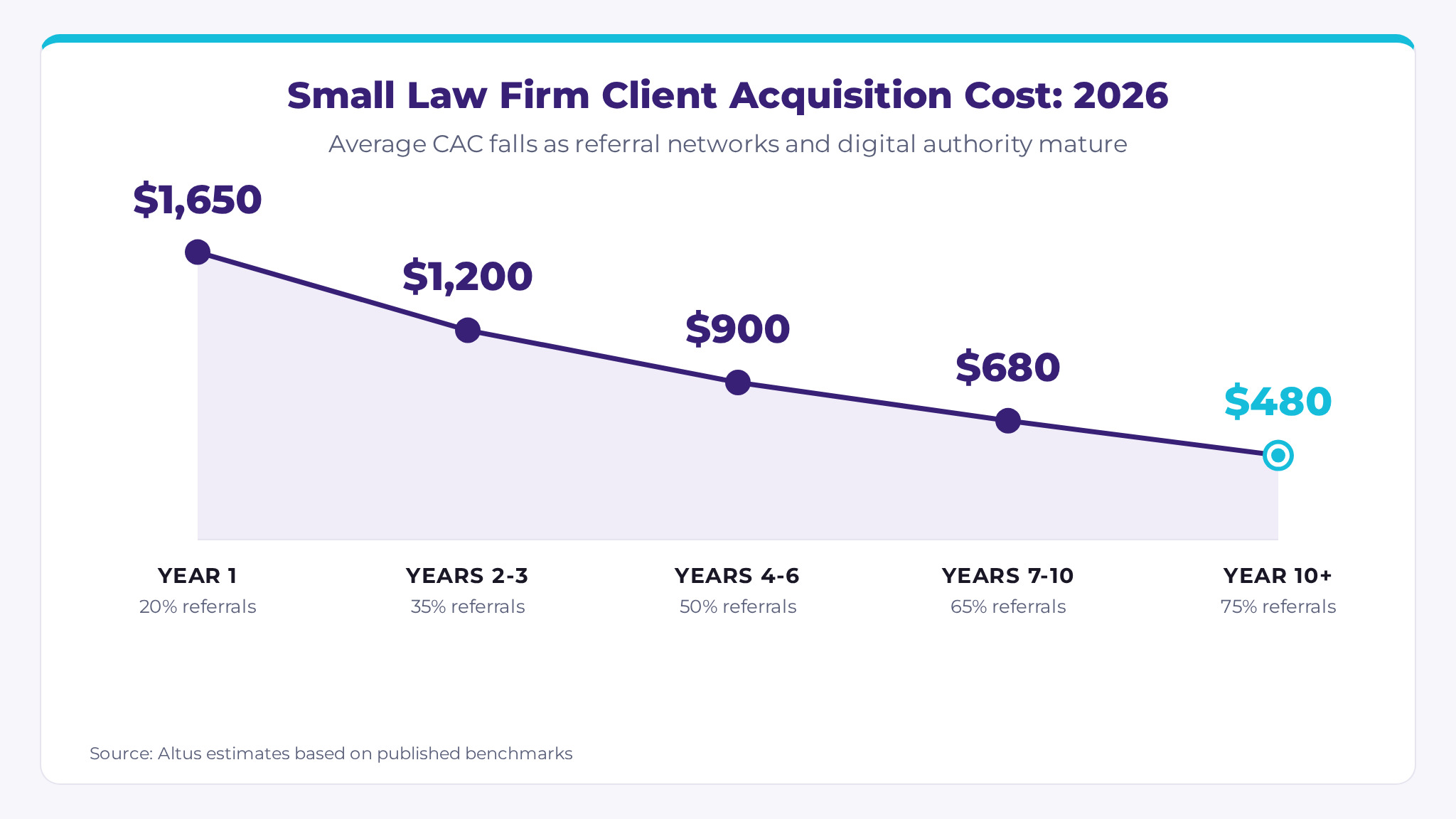
This table shows how small law firm CAC trends over time as referral networks mature, digital authority compounds, and the firm’s overall market reputation develops. The referral and digital share columns reflect the typical channel mix at each stage.
| Firm Age | Avg. CAC | Referral Share of New Clients | Digital Share | Context |
|---|---|---|---|---|
| Year 1 | $1,650 | 20% | 65% | Building presence from scratch; highest CAC period |
| Years 2-3 | $1,200 | 35% | 50% | Referral reputation starting to compound |
| Years 4-6 | $900 | 50% | 40% | Established local visibility, maturing network |
| Years 7-10 | $680 | 65% | 30% | Strong referral pipeline with digital reinforcing it |
| Year 10+ | $480 | 75% | 20% | Mature firm; digital maintains positioning |
- Year one carries the highest CAC in a small firm’s lifecycle because brand presence, local citation authority, and referral relationships are all being built simultaneously with no existing momentum in any channel.
- The most significant CAC improvement typically occurs between years two and four, when referral share crosses 30% and begins compounding against the organic authority that SEO investment in year one has been accumulating.
- Firms that reach years seven to ten with a strong referral pipeline can reduce digital spend while sustaining client volume, though practices that cut digital entirely at this stage tend to see referral share erode over the following two to three years as their search visibility fades.
- Small firms that invest in SEO and GEO content infrastructure in their first three years typically move through this curve faster than those that relied primarily on paid channels in early years, because organic and content assets compound in value while paid spend resets to zero when the budget stops.
If you’d like a PDF copy of this report or help lowering your small law firm’s client acquisition cost, contact Altus.
Sources
- Clio Legal Trends Report - Annual law firm economics and client acquisition benchmarks
- American Bar Association Profile of the Legal Profession - Solo and small firm practice data
- Martindale-Avvo Legal Consumer Research - Consumer search behavior and directory performance for small firms
- Thomson Reuters Institute - Law firm financial and operational benchmarking by firm size
- National Law Review - Legal industry marketing and business development coverage